TOmicsVis
1. Introduction
TOmicsVis: An all-in-one transcriptomic analysis and visualization R package with Shiny app interface.
Current Version: 0.99.0 (2026-05-18)
SourceCode: https://github.com/benben-miao/TOmicsVis/
Website API: https://benben-miao.github.io/TOmicsVis/
Citation:
citation(package = "TOmicsVis")
Miao, Ben-Ben, Dong, Wei, Han, Zhao-Fang, Luo, Xuan, Ke, Cai-Huan, and You, Wei-Wei. 2023. “ TOmicsVis: An All-in-One Transcriptomic Analysis and Visualization R Package with shinyapp Interface.” iMeta e137. https://doi.org/10.1002/imt2.137
1.1 TOmicsVis Shinyapp
1.1.1 Local start funcion:
# Start shiny application.
TOmicsVis::tomicsvis()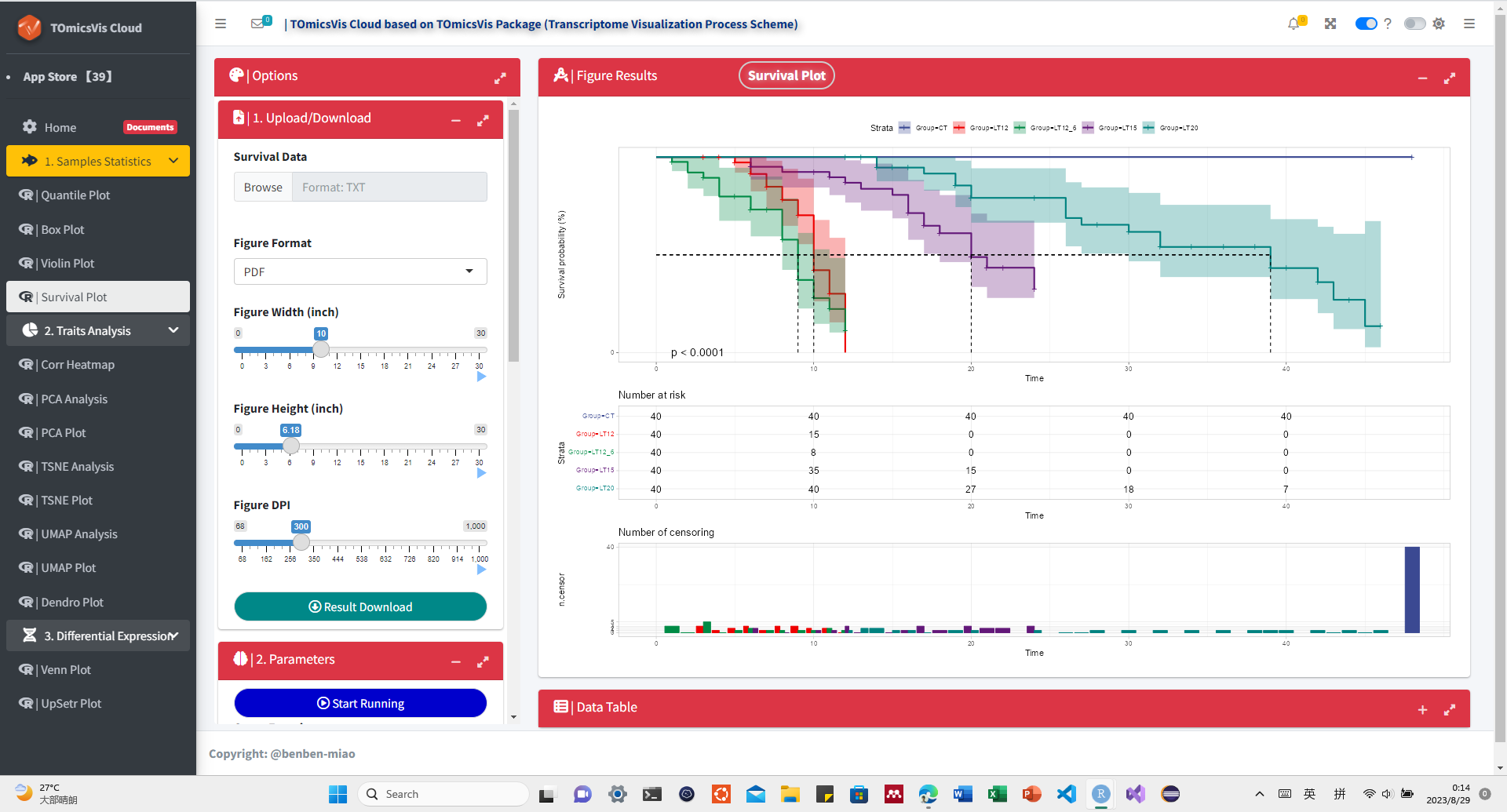
1.1.2 Online cloud platform: https://shiny.hiplot.cn/tomicsvis-shiny/
1.2 Github and CRAN Install
1.2.1 Install required packages from Bioconductor:
# Install required packages from Bioconductor
install.packages("BiocManager")
BiocManager::install(c("ComplexHeatmap", "EnhancedVolcano", "clusterProfiler", "enrichplot", "impute", "preprocessCore", "Mfuzz"))
1.2.2 Github: https://github.com/benben-miao/TOmicsVis/
Install from Github:
install.packages("devtools")
devtools::install_github("benben-miao/TOmicsVis")

# Resolve network by GitClone
devtools::install_git("https://gitclone.com/github.com/benben-miao/TOmicsVis.git")
1.2.3 CRAN: https://cran.r-project.org/package=TOmicsVis
Install from CRAN:
# Install from CRAN
install.packages("TOmicsVis")
2. Library packages
2.2 Recommended loading method (suppress warnings)
# Use load_TOmicsVis() to suppress harmless display warnings from Mfuzz dependency
load_TOmicsVis()
# Output: ✓ TOmicsVis v2.7.1 loaded successfully!
#         All functions ready to use.

# Then use all functions normally
data(gene_expression)
volcano_plot(degs_stats)
3. Usage cases
3.1 Samples Statistics
3.1.1 quantile_plot
Input Data: Dataframe: Weight and Sex traits dataframe (1st-col: Weight, 2nd-col: Sex).
Output Plot: Quantile plot for visualizing data distribution.
# 1. Load example datasets
data(weight_sex)
head(weight_sex)
#>   Weight    Sex
#> 1  36.74 Female
#> 2  38.54 Female
#> 3  44.91 Female
#> 4  43.53 Female
#> 5  39.03 Female
#> 6  26.01 Female

# 2. Run quantile_plot plot function
quantile_plot(
  data = weight_sex,
  my_shape = "fill_circle",
  point_size = 1.5,
  conf_int = TRUE,
  conf_level = 0.95,
  split_panel = "Split_Panel",
  legend_pos = "right",
  legend_dir = "vertical",
  sci_fill_color = "Sci_NPG",
  sci_color_alpha = 0.75,
  ggTheme = "theme_publication"
)
Get help using command ?TOmicsVis::quantile_plot or
reference page https://benben-miao.github.io/TOmicsVis/reference/quantile_plot.html.
# Get help with command in R console.
# ?TOmicsVis::quantile_plot
3.1.2 box_plot
Input Data: Dataframe: Length, Width, Weight, and Sex traits dataframe (1st-col: Value, 2nd-col: Traits, 3rd-col: Sex).
Output Plot: Plot: Box plot support two levels and multiple groups with P value.
# 1. Load example datasets
data(traits_sex)
head(traits_sex)
#>   Value Traits    Sex
#> 1 36.74 Weight Female
#> 2 38.54 Weight Female
#> 3 44.91 Weight Female
#> 4 43.53 Weight Female
#> 5 39.03 Weight Female
#> 6 26.01 Weight Female

# 2. Run box_plot plot function
box_plot(
  data = traits_sex,
  test_method = "t.test",
  test_label = "p.format",
  notch = TRUE,
  group_level = "Three_Column",
  add_element = "jitter",
  my_shape = "fill_circle",
  sci_fill_color = "Sci_AAAS",
  sci_fill_alpha = 0.5,
  sci_color_alpha = 1,
  legend_pos = "right",
  legend_dir = "vertical",
  ggTheme = "theme_publication"
)
Get help using command ?TOmicsVis::box_plot or reference
page https://benben-miao.github.io/TOmicsVis/reference/box_plot.html.
# Get help with command in R console.
# ?TOmicsVis::box_plot
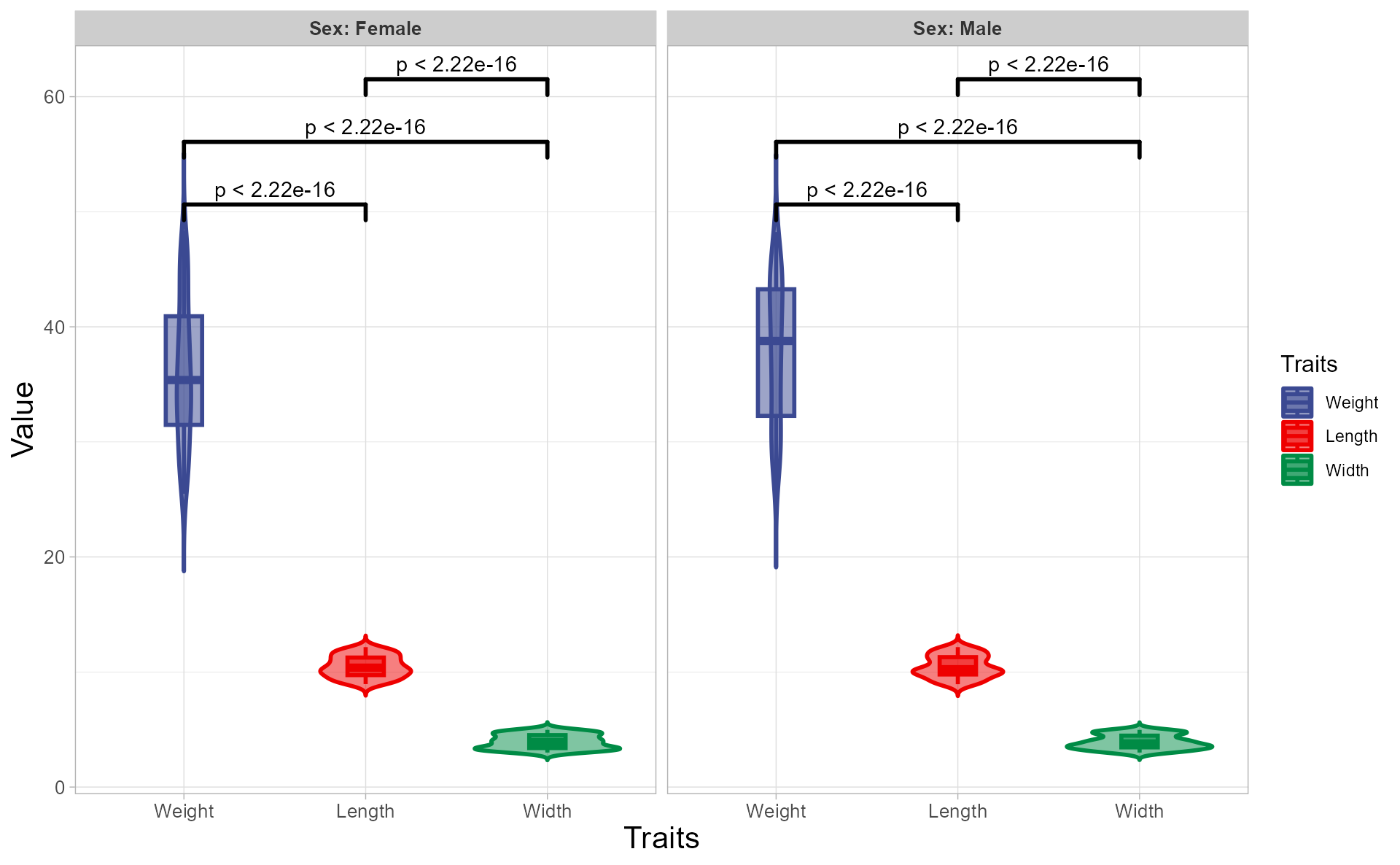
3.1.3 violin_plot
Input Data: Dataframe: Length, Width, Weight, and Sex traits dataframe (1st-col: Value, 2nd-col: Traits, 3rd-col: Sex).
Output Plot: Plot: Violin plot support two levels and multiple groups with P value.
# 1. Load example datasets
data(traits_sex)

# 2. Run violin_plot plot function
violin_plot(
  data = traits_sex,
  test_method = "t.test",
  test_label = "p.format",
  group_level = "Three_Column",
  violin_orientation = "vertical",
  add_element = "boxplot",
  element_alpha = 0.5,
  my_shape = "plus_times",
  sci_fill_color = "Sci_AAAS",
  sci_fill_alpha = 0.5,
  sci_color_alpha = 1,
  legend_pos = "right",
  legend_dir = "vertical",
  ggTheme = "theme_publication"
)
Get help using command ?TOmicsVis::violin_plot or
reference page https://benben-miao.github.io/TOmicsVis/reference/violin_plot.html.
# Get help with command in R console.
# ?TOmicsVis::violin_plot
3.1.4 survival_plot
Input Data: Dataframe: survival record data (1st-col: Time, 2nd-col: Status, 3rd-col: Group).
Output Plot: Survival plot for analyzing and visualizing survival data.
# 1. Load example datasets
data(survival_data)
head(survival_data)
#>   Time Status Group
#> 1   48      0    CT
#> 2   48      0    CT
#> 3   48      0    CT
#> 4   48      0    CT
#> 5   48      0    CT
#> 6   48      0    CT

# 2. Run survival_plot plot function
survival_plot(
  data = survival_data,
  curve_function = "pct",
  conf_inter = TRUE,
  interval_style = "ribbon",
  risk_table = TRUE,
  num_censor = TRUE,
  sci_palette = "aaas",
  ggTheme = "theme_publication",
  x_start = 0,
  y_start = 0,
  y_end = 100,
  x_break = 10
)
#> Ignoring unknown labels:
#> • colour : "Strata"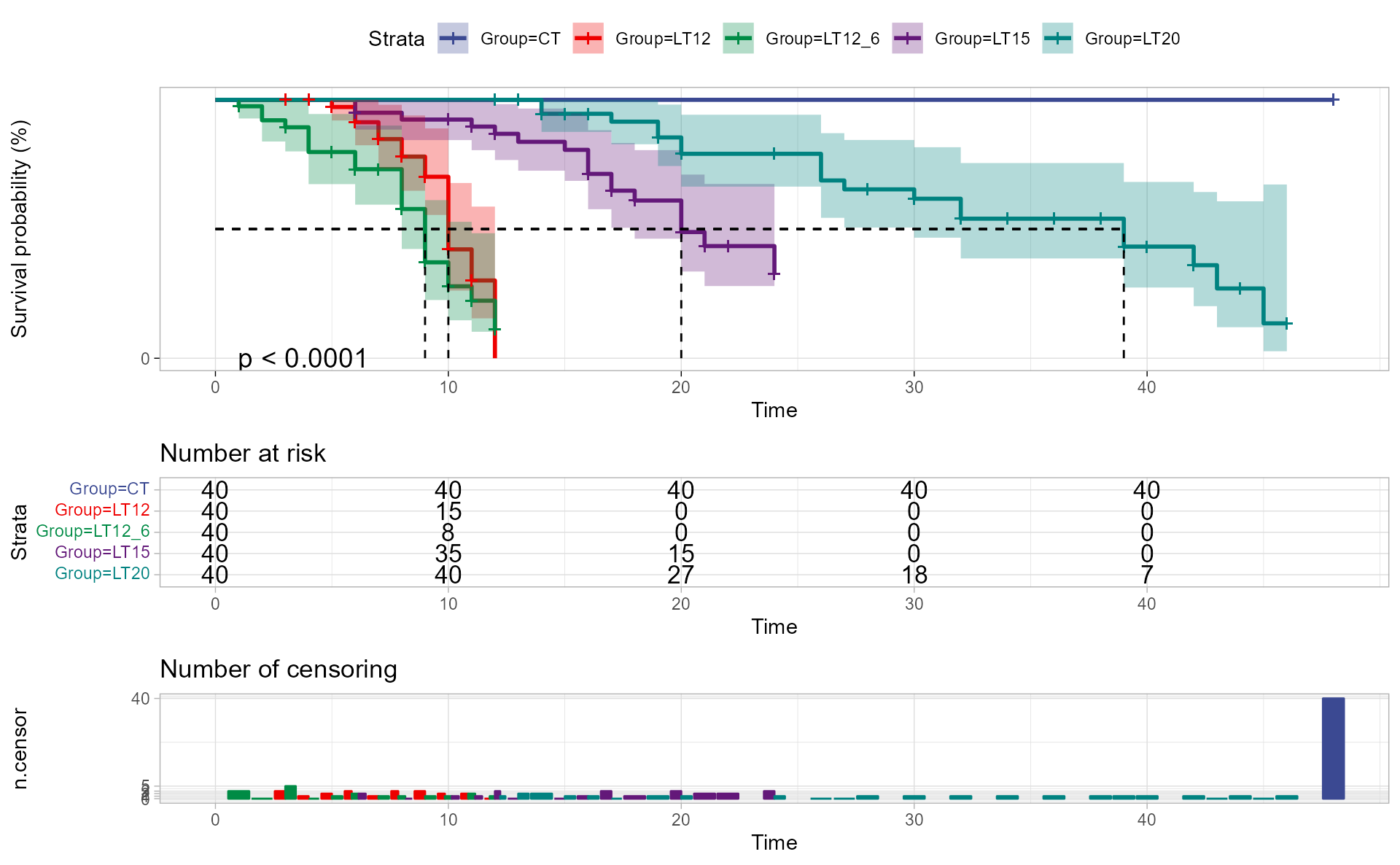
Get help using command ?TOmicsVis::survival_plot or
reference page https://benben-miao.github.io/TOmicsVis/reference/survival_plot.html.
# Get help with command in R console.
# ?TOmicsVis::survival_plot
3.2 Traits Analysis
3.2.1 corr_heatmap
Input Data: Dataframe: All genes in all samples expression dataframe of RNA-Seq (1st-col: Genes, 2nd-col~: Samples).
Output Plot: Plot: heatmap plot filled with Pearson correlation values and P values.
# 1. Load example dataset
data(gene_expression)
head(gene_expression)
#>              Genes   CT_1   CT_2   CT_3 LT20_1 LT20_2 LT20_3 LT15_1 LT15_2
#> 1     transcript_0 655.78 631.08 669.89 654.21 402.56 447.09 510.08 442.22
#> 2     transcript_1  92.72 112.26 150.30  88.35  76.35  94.55 120.24  80.89
#> 3    transcript_10  21.74  31.11  22.58  15.09  13.67  13.24  12.48   7.53
#> 4   transcript_100   0.00   0.00   0.00   0.00   0.00   0.00   0.00   0.00
#> 5  transcript_1000   0.00  14.15  36.01   0.00   0.00 193.59 208.45   0.00
#> 6 transcript_10000  89.18 158.04  86.28  82.97 117.78 102.24 129.61 112.73
#>   LT15_3 LT12_1 LT12_2 LT12_3 LT12_6_1 LT12_6_2 LT12_6_3
#> 1 399.82 483.30 437.89 444.06   405.43   416.63   464.75
#> 2  73.94  96.25  82.62  85.48    65.12    61.94    73.44
#> 3  13.35  11.16  11.36   6.96     7.82     4.01    10.02
#> 4   0.00   0.00   0.00   0.00     0.00     0.00     0.00
#> 5 232.40 148.58   0.00 181.61     0.02    12.18     0.00
#> 6  85.70  80.89 124.11 115.25   113.87   107.69   119.83

# 2. Run corr_heatmap plot function
corr_heatmap(
  data = gene_expression,
  corr_method = "pearson",
  cell_shape = "square",
  fill_type = "full",
  lable_size = 3,
  axis_angle = 45,
  axis_size = 12,
  lable_digits = 3,
  color_low = "blue",
  color_mid = "white",
  color_high = "red",
  outline_color = "white",
  ggTheme = "theme_publication"
)
#> Warning: `aes_string()` was deprecated in ggplot2 3.0.0.
#> ℹ Please use tidy evaluation idioms with `aes()`.
#> ℹ See also `vignette("ggplot2-in-packages")` for more information.
#> ℹ The deprecated feature was likely used in the ggcorrplot package.
#>   Please report the issue at <https://github.com/kassambara/ggcorrplot/issues>.
#> This warning is displayed once per session.
#> Call `lifecycle::last_lifecycle_warnings()` to see where this warning was
#> generated.
#> Scale for fill is already present.
#> Adding another scale for fill, which will replace the existing scale.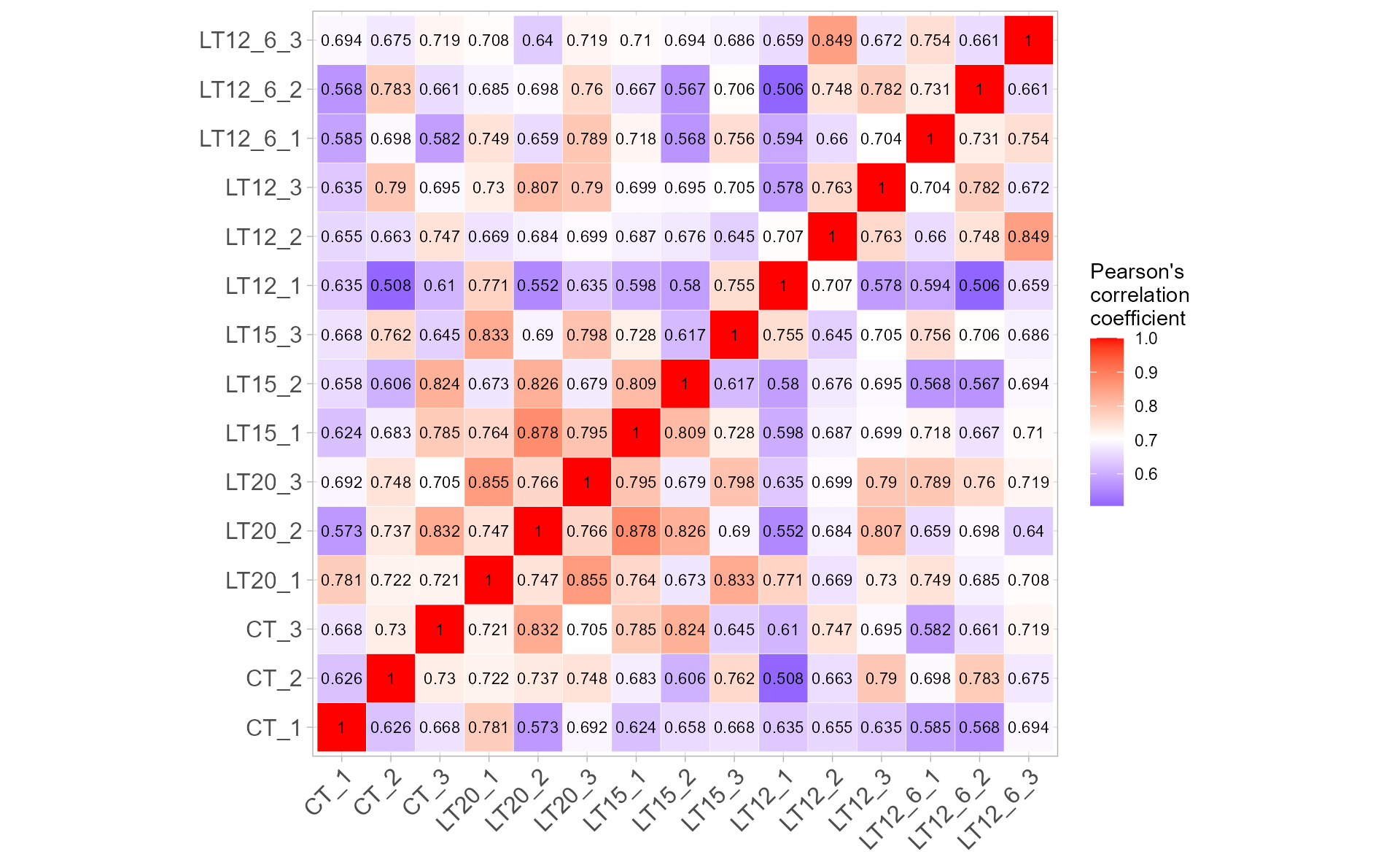
Get help using command ?TOmicsVis::corr_heatmap or
reference page https://benben-miao.github.io/TOmicsVis/reference/corr_heatmap.html.
# Get help with command in R console.
# ?TOmicsVis::corr_heatmap
3.2.2 pca_analysis
Input Data1: Dataframe: All genes in all samples expression dataframe of RNA-Seq (1st-col: Genes, 2nd-col~: Samples).
Input Data2: Dataframe: Samples and groups for gene expression (1st-col: Samples, 2nd-col: Groups).
Output Table: PCA dimensional reduction analysis for RNA-Seq.
# 1. Load example datasets
data(gene_expression)

data(samples_groups)
head(samples_groups)
#>   Samples Groups
#> 1    CT_1     CT
#> 2    CT_2     CT
#> 3    CT_3     CT
#> 4  LT20_1   LT20
#> 5  LT20_2   LT20
#> 6  LT20_3   LT20

# 2. Run pca_analysis plot function
res <- pca_analysis(gene_expression, samples_groups)
head(res)
#>               PC1         PC2         PC3        PC4         PC5       PC6
#> CT_1   -27010.536 -18328.2803   5955.2569 46547.7319  11394.1043 -7197.285
#> CT_2    16248.651  29132.9251   -824.1857 20747.9618 -18798.8755 21096.088
#> CT_3    22421.017 -26832.3964   6789.4490  5864.1171 -15375.3418 17424.861
#> LT20_1 -18587.073   -472.9036 -21638.7836  7765.9575    114.1225 -3943.968
#> LT20_2  33275.933  -9874.9959 -14991.3942 -7443.9250  -4600.8302 -8072.298
#> LT20_3  -1596.255  11683.5426 -10892.8493   381.0795  11080.3560 -8994.187
#>                PC7        PC8        PC9        PC10        PC11       PC12
#> CT_1     2150.6739   4850.320   4051.745   7666.9445  -3141.9327  -2487.939
#> CT_2   -12329.1138  -3353.734   4805.659   1503.8533  11184.0296  -4865.436
#> CT_3    12744.2255 -10037.516 -11468.842    202.4016 -11001.6260  -3847.291
#> LT20_1   8864.7482 -14171.127  -1968.082  -3562.1899   7446.2105  14831.486
#> LT20_2   -941.3943  -5072.401   5345.106   6494.1383  -3954.2153   9351.346
#> LT20_3   7263.9321  -7774.725  -1853.546 -21427.2641    -46.1503 -12507.011
#>              PC13       PC14          PC15
#> CT_1    -2704.613  2396.7383  4.266986e-11
#> CT_2    -2633.057 -1375.3352  1.484187e-11
#> CT_3     5193.978   188.5601  4.119713e-11
#> LT20_1   3937.457 -7871.8062  1.031765e-10
#> LT20_2 -12904.673  6071.6618 -8.107249e-11
#> LT20_3  -5369.380  2606.1762  5.619822e-11
Get help using command ?TOmicsVis::pca_analysis or
reference page https://benben-miao.github.io/TOmicsVis/reference/pca_analysis.html.
# Get help with command in R console.
# ?TOmicsVis::pca_analysis
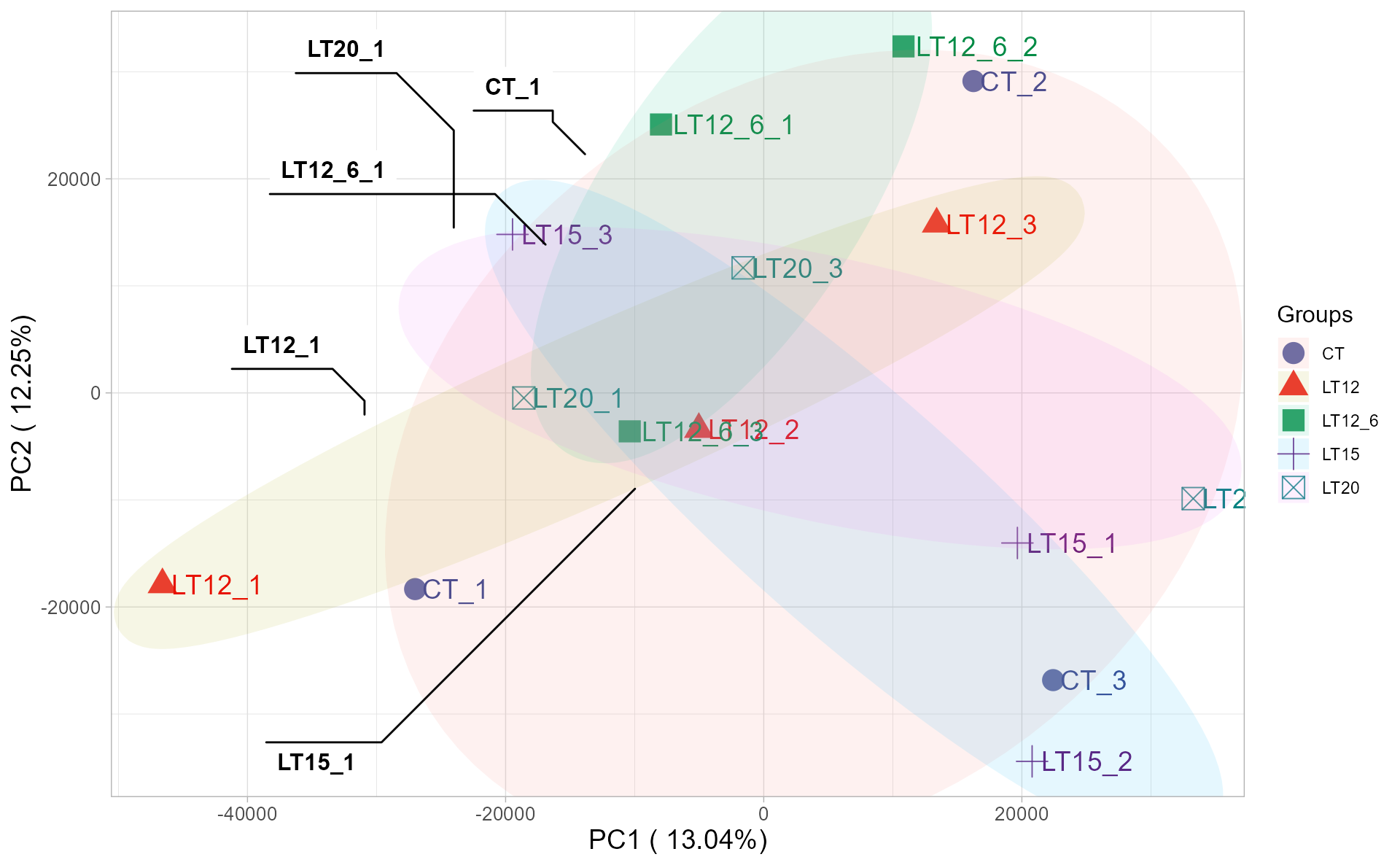
3.2.3 pca_plot
Input Data1: Dataframe: All genes in all samples expression dataframe of RNA-Seq (1st-col: Genes, 2nd-col~: Samples).
Input Data2: Dataframe: Samples and groups for gene expression (1st-col: Samples, 2nd-col: Groups).
Output Plot: Plot: PCA dimensional reduction visualization for RNA-Seq.
# 1. Load example datasets
data(gene_expression)

data(samples_groups)
head(samples_groups)
#>   Samples Groups
#> 1    CT_1     CT
#> 2    CT_2     CT
#> 3    CT_3     CT
#> 4  LT20_1   LT20
#> 5  LT20_2   LT20
#> 6  LT20_3   LT20

# 2. Run pca_plot plot function
pca_plot(
  sample_gene = gene_expression,
  group_sample = samples_groups,
  xPC = 1,
  yPC = 2,
  point_size = 5,
  text_size = 5,
  fill_alpha = 0.10,
  border_alpha = 0.00,
  legend_pos = "right",
  legend_dir = "vertical",
  ggTheme = "theme_publication"
)
Get help using command ?TOmicsVis::pca_plot or reference
page https://benben-miao.github.io/TOmicsVis/reference/pca_plot.html.
# Get help with command in R console.
# ?TOmicsVis::pca_plot
3.2.4 tsne_analysis
Input Data1: Dataframe: All genes in all samples expression dataframe of RNA-Seq (1st-col: Genes, 2nd-col~: Samples).
Input Data2: Dataframe: Samples and groups for gene expression (1st-col: Samples, 2nd-col: Groups).
Output Table: TSNE analysis for analyzing and visualizing TSNE algorithm.
# 1. Load example datasets
data(gene_expression)
data(samples_groups)

# 2. Run tsne_analysis plot function
res <- tsne_analysis(gene_expression, samples_groups)
head(res)
#>        TSNE1      TSNE2
#> 1 -42.225357 -140.97093
#> 2 128.457705  -53.68764
#> 3  87.077218  109.44526
#> 4  -1.897099 -102.18232
#> 5  55.971032   56.80090
#> 6   9.988991  -67.08253
Get help using command ?TOmicsVis::tsne_analysis or
reference page https://benben-miao.github.io/TOmicsVis/reference/tsne_analysis.html.
# Get help with command in R console.
# ?TOmicsVis::tsne_analysis
3.2.5 tsne_plot
Input Data1: Dataframe: All genes in all samples expression dataframe of RNA-Seq (1st-col: Genes, 2nd-col~: Samples).
Input Data2: Dataframe: Samples and groups for gene expression (1st-col: Samples, 2nd-col: Groups).
Output Plot: TSNE plot for analyzing and visualizing TSNE algorithm.
# 1. Load example datasets
data(gene_expression)
data(samples_groups)

# 2. Run tsne_plot plot function
tsne_plot(
  sample_gene = gene_expression,
  group_sample = samples_groups,
  multi_shape = FALSE,
  point_size = 5,
  point_alpha = 0.8,
  text_size = 5,
  text_alpha = 0.80,
  fill_alpha = 0.10,
  border_alpha = 0.00,
  sci_fill_color = "Sci_AAAS",
  legend_pos = "right",
  legend_dir = "vertical",
  ggTheme = "theme_publication"
)
#> Ignoring unknown labels:
#> • shape : "Groups"
Get help using command ?TOmicsVis::tsne_plot or
reference page https://benben-miao.github.io/TOmicsVis/reference/tsne_plot.html.
# Get help with command in R console.
# ?TOmicsVis::tsne_plot
3.2.6 umap_analysis
Input Data1: Dataframe: All genes in all samples expression dataframe of RNA-Seq (1st-col: Genes, 2nd-col~: Samples).
Input Data2: Dataframe: Samples and groups for gene expression (1st-col: Samples, 2nd-col: Groups).
Output Table: UMAP analysis for analyzing RNA-Seq data.
# 1. Load example datasets
data(gene_expression)
data(samples_groups)

# 2. Run umap_analysis function
res <- umap_analysis(gene_expression, samples_groups)
head(res)
#>             UMAP1      UMAP2
#> CT_1   -0.1726118  0.5259924
#> CT_2   -1.4639928 -0.4470122
#> CT_3    1.0040735  0.2153305
#> LT20_1 -0.7061129  0.2556323
#> LT20_2  1.1941543 -0.5145478
#> LT20_3 -0.3920039 -0.4572853
Get help using command ?TOmicsVis::umap_analysis or
reference page https://benben-miao.github.io/TOmicsVis/reference/umap_analysis.html.
# Get help with command in R console.
# ?TOmicsVis::umap_analysis
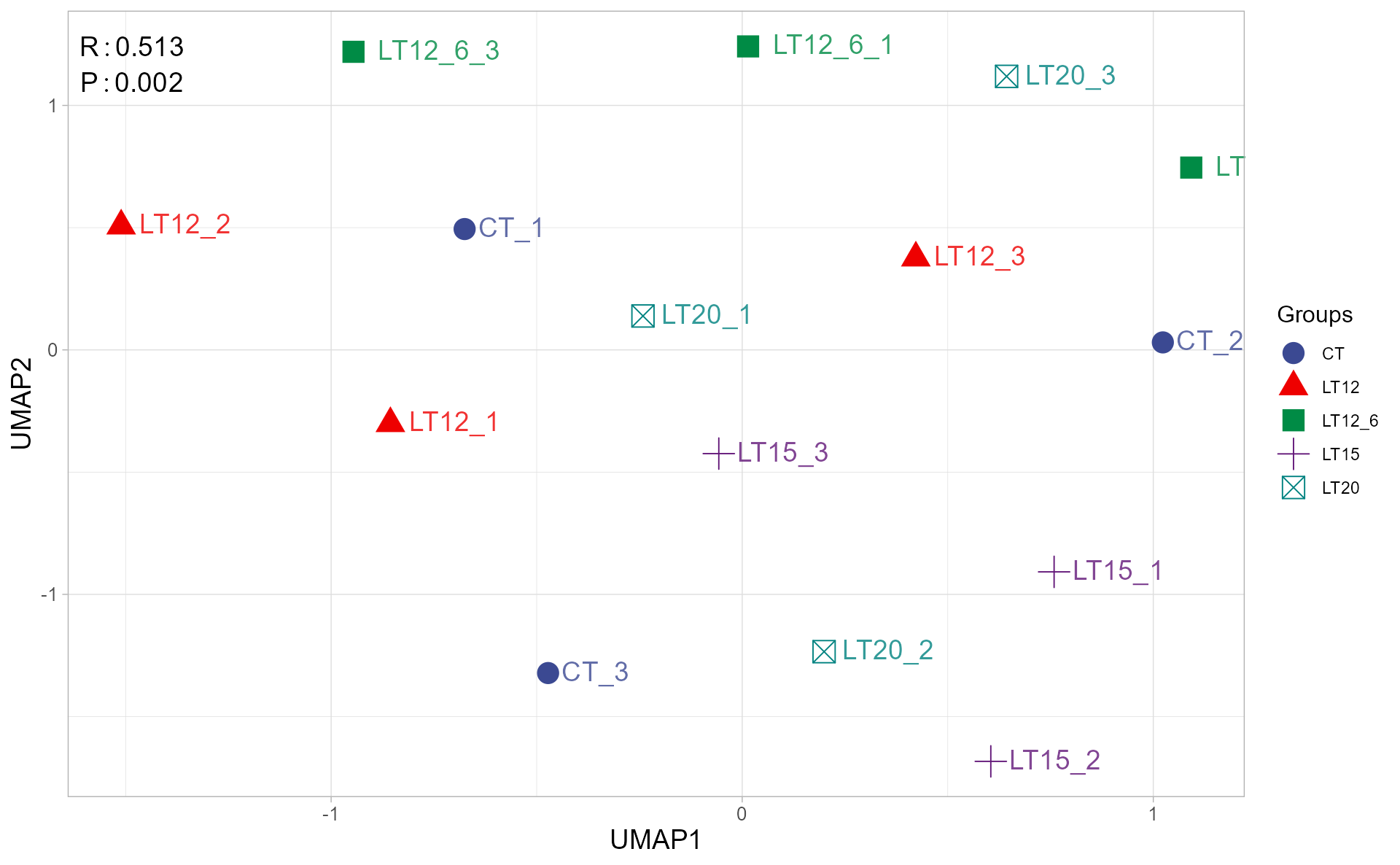
3.2.7 umap_plot
Input Data1: Dataframe: All genes in all samples expression dataframe of RNA-Seq (1st-col: Genes, 2nd-col~: Samples).
Input Data2: Dataframe: Samples and groups for gene expression (1st-col: Samples, 2nd-col: Groups).
Output Plot: UMAP plot for analyzing and visualizing UMAP algorithm.
# 1. Load example datasets
data(gene_expression)
data(samples_groups)

# 2. Run tsne_plot plot function
umap_plot(
  sample_gene = gene_expression,
  group_sample = samples_groups,
  multi_shape = TRUE,
  point_size = 5,
  point_alpha = 1,
  text_size = 5,
  text_alpha = 0.80,
  fill_alpha = 0.00,
  border_alpha = 0.00,
  sci_fill_color = "Sci_AAAS",
  legend_pos = "right",
  legend_dir = "vertical",
  ggTheme = "theme_publication"
)
Get help using command ?TOmicsVis::umap_plot or
reference page https://benben-miao.github.io/TOmicsVis/reference/umap_plot.html.
# Get help with command in R console.
# ?TOmicsVis::umap_plot
3.2.8 dendro_plot
Input Data: Dataframe: All genes in all samples expression dataframe of RNA-Seq (1st-col: Genes, 2nd-col~: Samples).
Output Plot: Plot: dendrogram for multiple samples clustering.
# 1. Load example datasets
data(gene_expression)

# 2. Run plot function
dendro_plot(
  data = gene_expression,
  dist_method = "euclidean",
  hc_method = "ward.D2",
  tree_type = "rectangle",
  k_num = 5,
  palette = "npg",
  color_labels_by_k = TRUE,
  horiz = FALSE,
  label_size = 1,
  line_width = 1,
  rect = TRUE,
  rect_fill = TRUE,
  xlab = "Samples",
  ylab = "Height",
  ggTheme = "theme_publication"
)
#> Registered S3 method overwritten by 'dendextend':
#>   method     from
#>   rev.hclust vegan
Get help using command ?TOmicsVis::dendro_plot or
reference page https://benben-miao.github.io/TOmicsVis/reference/dendro_plot.html.
# Get help with command in R console.
# ?TOmicsVis::dendro_plot
3.3 Differential Expression Analyais
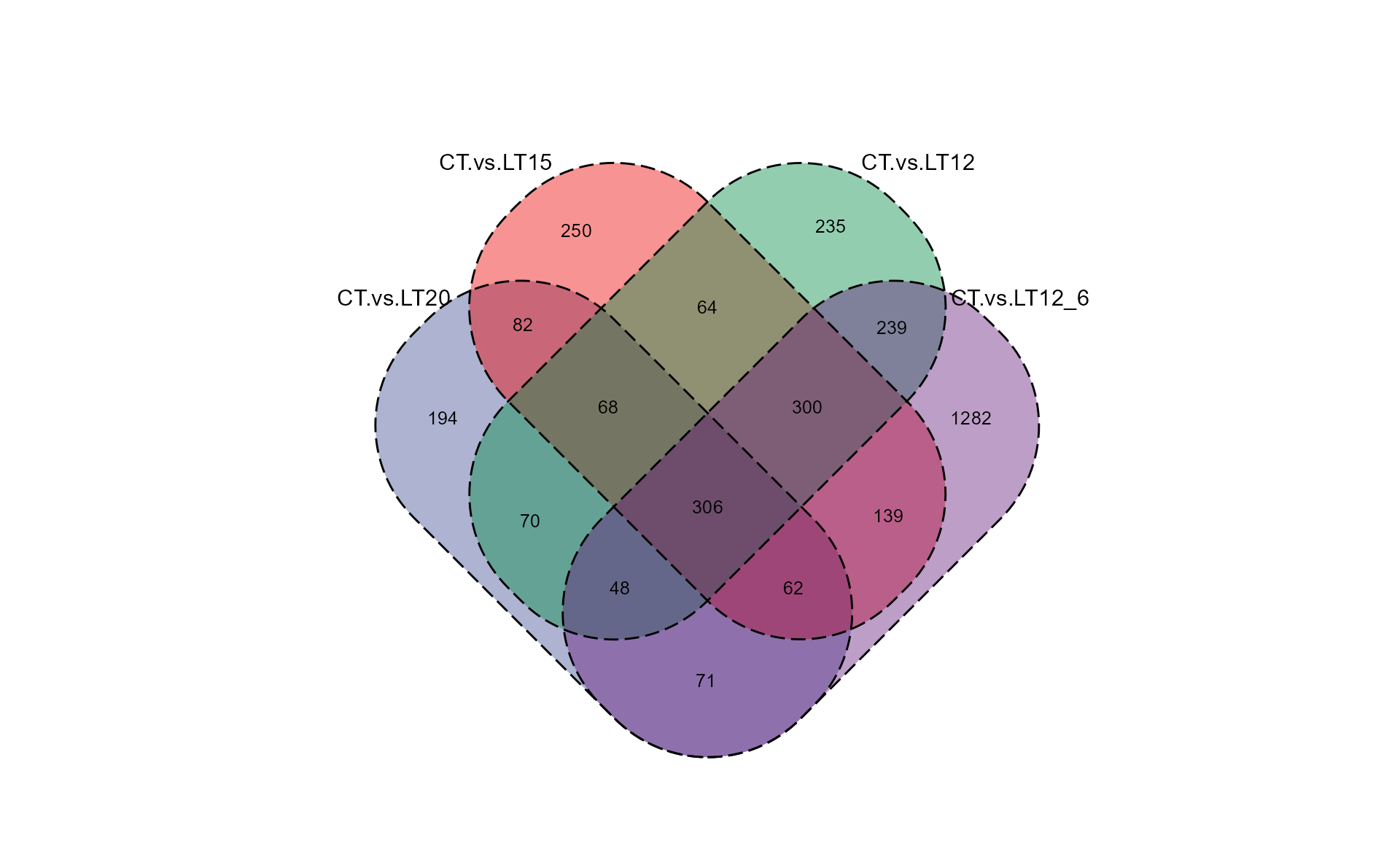
3.3.1 venn_plot
Input Data2: Dataframe: Paired comparisons differentially expressed genes (degs) among groups (1st-col~: degs of paired comparisons).
Output Plot: Venn plot for stat common and unique gene among multiple sets.
# 1. Load example datasets
data(degs_lists)
head(degs_lists)
#>        CT.vs.LT20      CT.vs.LT15       CT.vs.LT12     CT.vs.LT12_6
#> 1 transcript_9024 transcript_4738  transcript_9956 transcript_10354
#> 2  transcript_604 transcript_6050  transcript_7601  transcript_2959
#> 3 transcript_3912 transcript_1039  transcript_5960  transcript_5919
#> 4 transcript_8676 transcript_1344  transcript_3240  transcript_2395
#> 5 transcript_8832 transcript_3069 transcript_10224  transcript_9881
#> 6   transcript_74 transcript_9809  transcript_3151  transcript_8836

# 2. Run venn_plot plot function
venn_plot(
  data = degs_lists,
    title_size = 1.2,
    label_show = TRUE,
    label_size = 1,
    border_show = TRUE,
    line_type = "solid",
    ellipse_shape = "circle",
    color_scheme = "Vibrant",
    fill_alpha = 0.55
)
Get help using command ?TOmicsVis::venn_plot or
reference page https://benben-miao.github.io/TOmicsVis/reference/venn_plot.html.
# Get help with command in R console.
# ?TOmicsVis::venn_plot
3.3.2 upsetr_plot
Input Data2: Dataframe: Paired comparisons differentially expressed genes (degs) among groups (1st-col~: degs of paired comparisons).
Output Plot: UpSet plot for stat common and unique gene among multiple sets.
# 1. Load example datasets
data(degs_lists)
head(degs_lists)
#>        CT.vs.LT20      CT.vs.LT15       CT.vs.LT12     CT.vs.LT12_6
#> 1 transcript_9024 transcript_4738  transcript_9956 transcript_10354
#> 2  transcript_604 transcript_6050  transcript_7601  transcript_2959
#> 3 transcript_3912 transcript_1039  transcript_5960  transcript_5919
#> 4 transcript_8676 transcript_1344  transcript_3240  transcript_2395
#> 5 transcript_8832 transcript_3069 transcript_10224  transcript_9881
#> 6   transcript_74 transcript_9809  transcript_3151  transcript_8836

# 2. Run upsetr_plot plot function
upsetr_plot(
  data = degs_lists,
  sets_num = 4,
  keep_order = FALSE,
  order_by = "freq",
  decrease = TRUE,
  mainbar_color = "#006600",
  number_angle = 45,
  matrix_color = "#cc0000",
  point_size = 4.5,
  point_alpha = 0.5,
  line_size = 0.8,
  shade_color = "#cdcdcd",
  shade_alpha = 0.5,
  setsbar_color = "#000066",
  setsnum_size = 6,
  text_scale = 1.2
)
Get help using command ?TOmicsVis::upsetr_plot or
reference page https://benben-miao.github.io/TOmicsVis/reference/upsetr_plot.html.
# Get help with command in R console.
# ?TOmicsVis::upsetr_plot
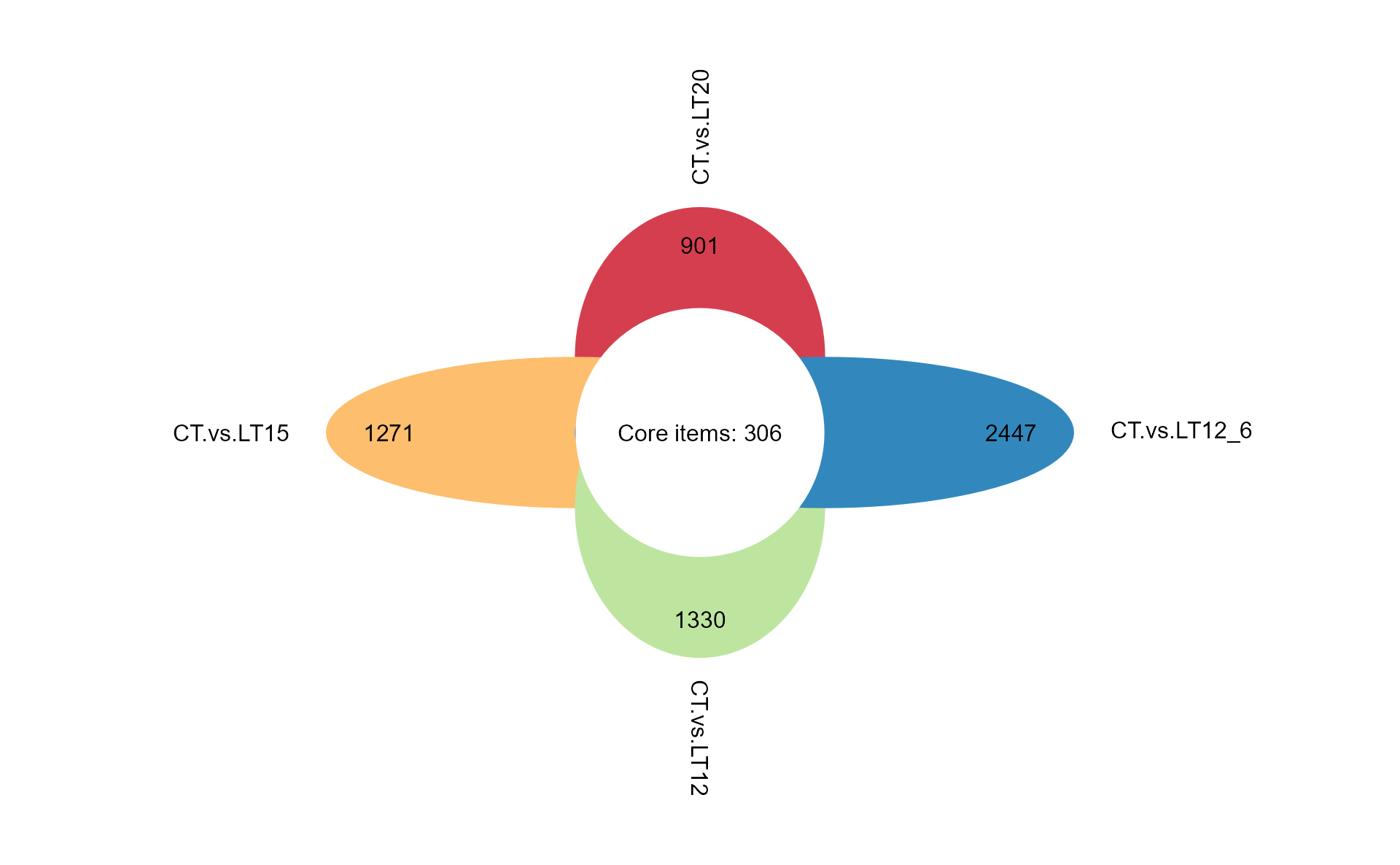
3.3.3 flower_plot
Input Data2: Dataframe: Paired comparisons differentially expressed genes (degs) among groups (1st-col~: degs of paired comparisons).
Output Plot: Flower plot for stat common and unique gene among multiple sets.
# 1. Load example datasets
data(degs_lists)

# 2. Run plot function
flower_plot(
  flower_dat = degs_lists,
  angle = 90,
  a = 1,
  b = 2,
  r = 1,
  ellipse_col_pal = "Spectral",
  circle_col = "white",
  label_text_cex = 1
)
Get help using command ?TOmicsVis::flower_plot or
reference page https://benben-miao.github.io/TOmicsVis/reference/flower_plot.html.
# Get help with command in R console.
# ?TOmicsVis::flower_plot
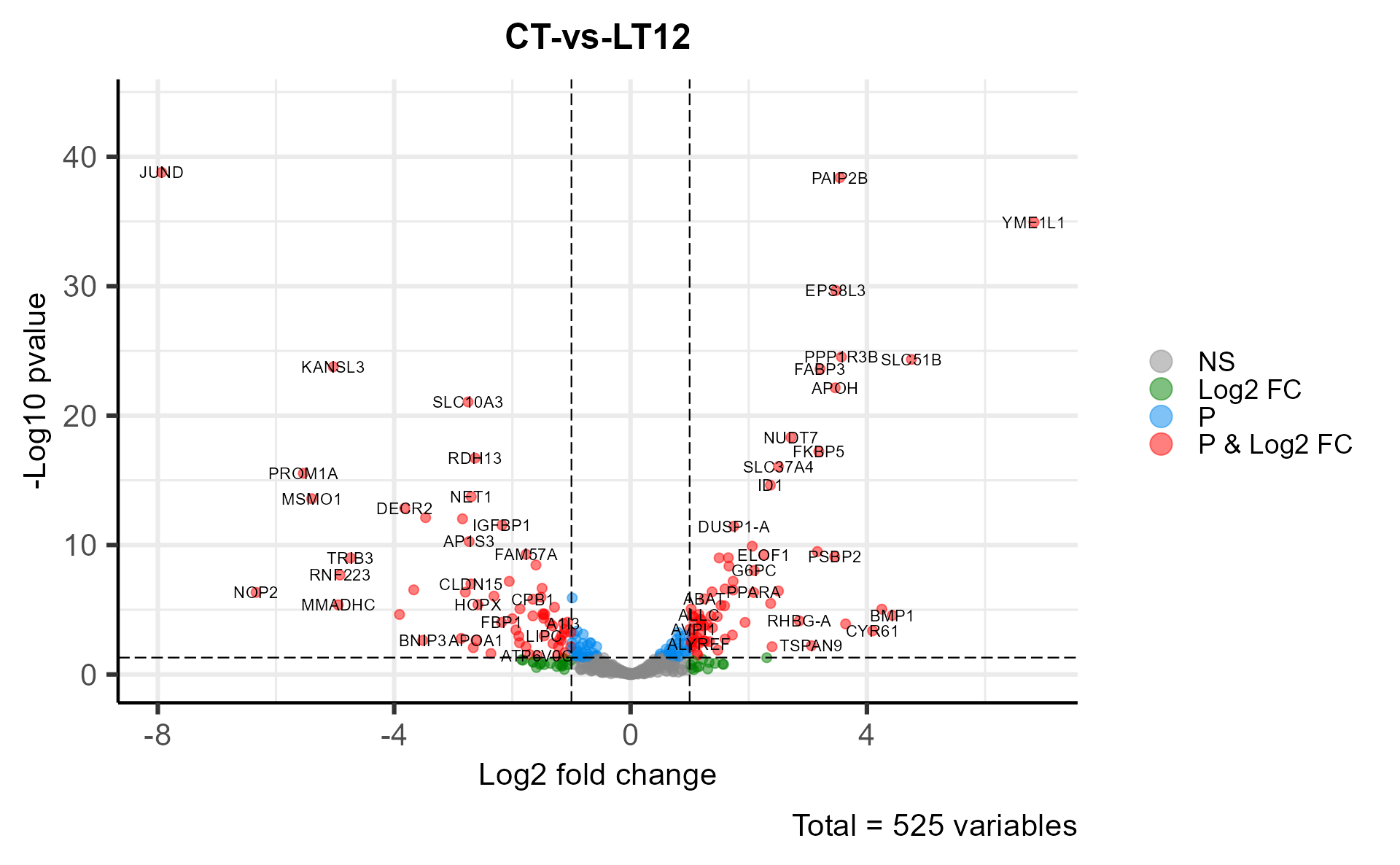
3.3.4 volcano_plot
Input Data2: Dataframe: All DEGs of paired comparison CT-vs-LT12 stats dataframe (1st-col: Genes, 2nd-col: log2FoldChange, 3rd-col: Pvalue, 4th-col: FDR).
Output Plot: Volcano plot for visualizing differentailly expressed genes.
# 1. Load example datasets
data(degs_stats)
head(degs_stats)
#>    Gene log2FoldChange      Pvalue         FDR
#> 1  A1I3    -1.13855748 0.000111040 0.000862478
#> 2   A1M     0.59076131 0.070988041 0.192551708
#> 3   A2M     0.09297827 0.819706797 0.913893947
#> 4 A2ML1    -0.26940689 0.745374782 0.874295125
#> 5  ABAT     1.24811621 0.000001440 0.000016800
#> 6 ABCC3    -0.72947545 0.005171574 0.024228298

# 2. Run volcano_plot plot function
volcano_plot(
  data = degs_stats,
  title = "CT-vs-LT12",
  log2fc_cutoff = 1,
  pq_value = "pvalue",
  pq_cutoff = 0.05,
  cutoff_line = "longdash",
  point_shape = "large_circle",
  point_size = 2,
  point_alpha = 0.5,
  color_normal = "#888888",
  color_log2fc = "#008000",
  color_pvalue = "#0088ee",
  color_Log2fc_p = "#ff0000",
  label_size = 3,
  boxed_labels = FALSE,
  draw_connectors = FALSE,
  legend_pos = "right"
)
Get help using command ?TOmicsVis::volcano_plot or
reference page https://benben-miao.github.io/TOmicsVis/reference/volcano_plot.html.
# Get help with command in R console.
# ?TOmicsVis::volcano_plot
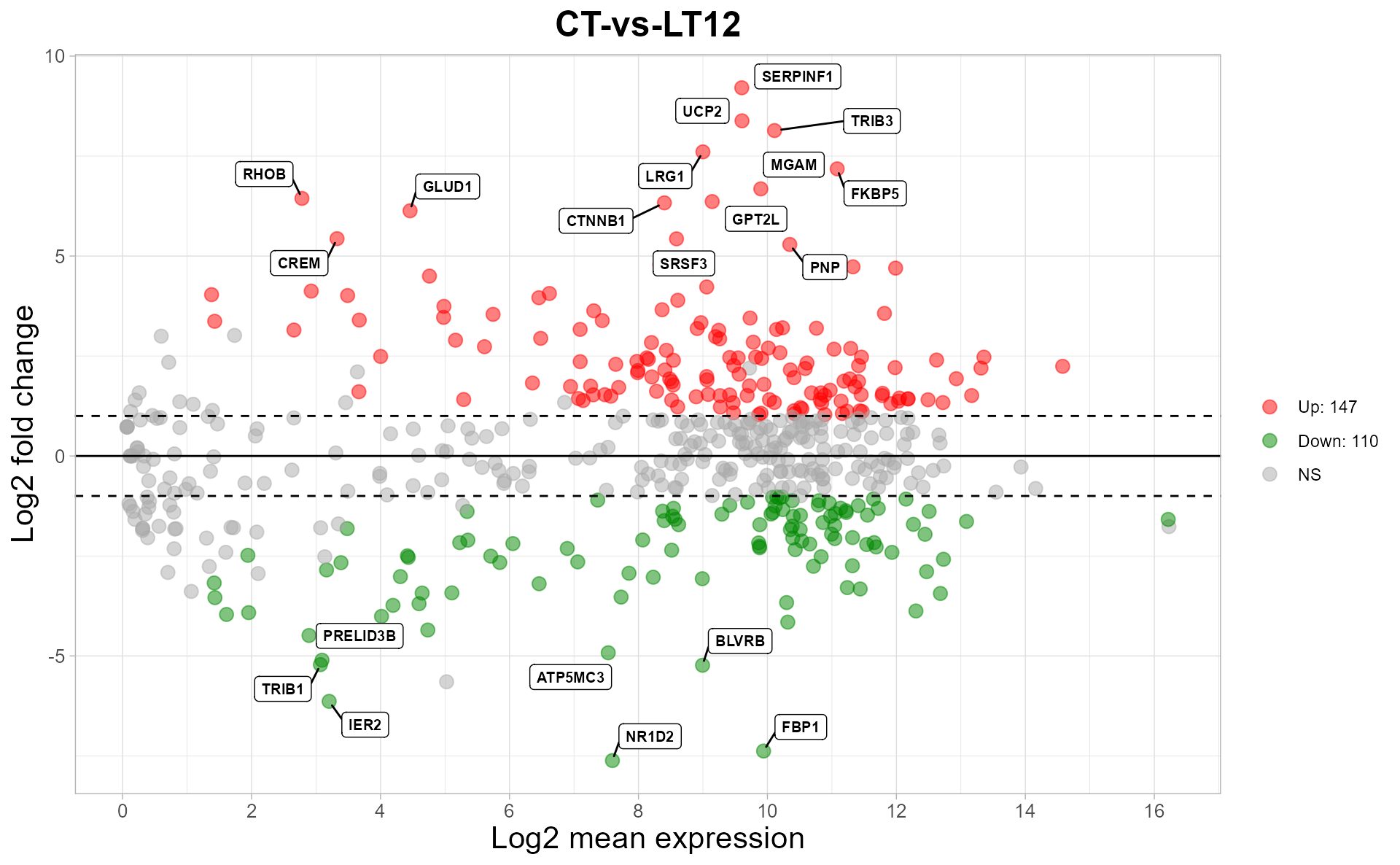
3.3.5 ma_plot
Input Data2: Dataframe: All DEGs of paired comparison CT-vs-LT12 stats2 dataframe (1st-col: Gene, 2nd-col: baseMean, 3rd-col: Log2FoldChange, 4th-col: FDR).
Output Plot: MversusA plot for visualizing differentially expressed genes.
# 1. Load example datasets
data(degs_stats2)
head(degs_stats2)
#>    name     baseMean log2FoldChange         padj
#> 1  A1I3    0.1184475      0.0000000           NA
#> 2   A1M 1654.4618140      0.6789538 5.280802e-02
#> 3   A2M  681.0463277      1.5263838 3.920000e-07
#> 4 A2ML1  389.7226640      3.8933573 1.180000e-14
#> 5  ABAT  364.7810090     -2.3554014 1.559230e-04
#> 6 ABCC3    1.1346239      1.2932740 4.491812e-01

# 2. Run volcano_plot plot function
ma_plot(
  data = degs_stats2,
  foldchange = 2,
  fdr_value = 0.05,
  point_size = 3.0,
  color_up = "#FF0000",
  color_down = "#008800",
  color_alpha = 0.5,
  top_method = "fc",
  top_num = 20,
  label_size = 8,
  label_box = TRUE,
  title = "CT-vs-LT12",
  xlab = "Log2 mean expression",
  ylab = "Log2 fold change",
  ggTheme = "theme_publication"
)
Get help using command ?TOmicsVis::ma_plot or reference
page https://benben-miao.github.io/TOmicsVis/reference/ma_plot.html.
# Get help with command in R console.
# ?TOmicsVis::ma_plot
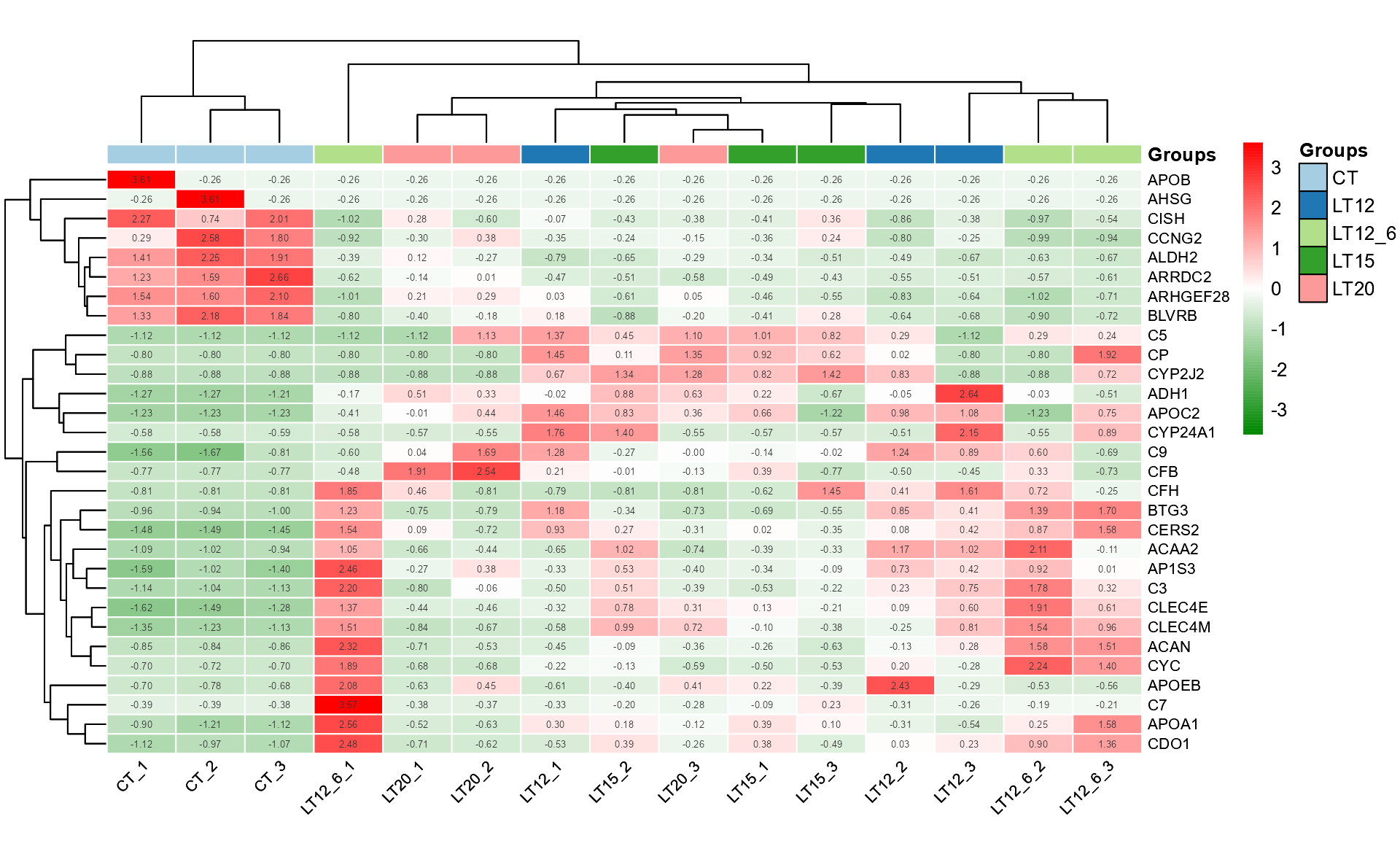
3.3.6 heatmap_group
Input Data1: Dataframe: Shared DEGs of all paired comparisons in all samples expression dataframe of RNA-Seq. (1st-col: Genes, 2nd-col~: Samples).
Input Data2: Dataframe: Samples and groups for gene expression (1st-col: Samples, 2nd-col: Groups).
Output Plot: Heatmap group for visualizing grouped gene expression data.
# 1. Load example datasets
data(gene_expression2)
data(samples_groups)

# 2. Run heatmap_group plot function
heatmap_group(
  sample_gene = gene_expression2[1:30,],
  group_sample = samples_groups,
  scale_data = "row",
  clust_method = "complete",
  border_show = TRUE,
  border_color = "#ffffff",
  value_show = TRUE,
  value_decimal = 2,
  value_size = 5,
  axis_size = 8,
  cell_height = 10,
  low_color = "#00880055",
  mid_color = "#ffffff",
  high_color = "#ff000055",
  na_color = "#ff8800",
  x_angle = 45
)
Get help using command ?TOmicsVis::heatmap_group or
reference page https://benben-miao.github.io/TOmicsVis/reference/heatmap_group.html.
# Get help with command in R console.
# ?TOmicsVis::heatmap_group
3.3.7 circos_heatmap
Input Data2: Dataframe: Shared DEGs of all paired comparisons in all samples expression dataframe of RNA-Seq. (1st-col: Genes, 2nd-col~: Samples).
Output Plot: Circos heatmap plot for visualizing gene expressing in multiple samples.
# 1. Load example datasets
data(gene_expression2)
head(gene_expression2)
#>   Genes  CT_1    CT_2  CT_3 LT20_1 LT20_2 LT20_3 LT15_1 LT15_2 LT15_3 LT12_1
#> 1 ACAA2 24.50   39.83 55.38 114.11 159.32  96.88 169.56 464.84 182.66 116.08
#> 2  ACAN 14.97   18.71 10.30  71.23 142.67 213.54 253.15 320.80 104.15 174.02
#> 3  ADH1  1.54    1.56  2.04  14.95  13.60  15.87  12.80  17.74   6.06  10.97
#> 4  AHSG  0.00 1911.99  0.00   0.00   0.00   0.00   0.00   0.00   0.00   0.00
#> 5 ALDH2  2.07    2.86  2.54   0.85   0.49   0.47   0.42   0.13   0.26   0.00
#> 6 AP1S3  6.62   14.59  9.30  24.90  33.94  23.19  24.00  36.08  27.40  24.06
#>   LT12_2 LT12_3 LT12_6_1 LT12_6_2 LT12_6_3
#> 1 497.29 464.48   471.43   693.62   229.77
#> 2 305.81 469.48  1291.90   991.90   966.77
#> 3  10.71  30.95     9.84    10.91     7.28
#> 4   0.00   0.00     0.00     0.00     0.00
#> 5   0.28   0.11     0.37     0.15     0.11
#> 6  38.74  34.54    62.72    41.36    28.75

# 2. Run circos_heatmap plot function
circos_heatmap(
  data = gene_expression2[1:50,],
  low_color = "#0000ff",
  mid_color = "#ffffff",
  high_color = "#ff0000",
  gap_size = 25,
  cluster_run = TRUE,
  cluster_method = "complete",
  distance_method = "euclidean",
  dend_show = "inside",
  dend_height = 0.2,
  track_height = 0.3,
  rowname_show = "outside",
  rowname_size = 0.8
)
Get help using command ?TOmicsVis::circos_heatmap or
reference page https://benben-miao.github.io/TOmicsVis/reference/circos_heatmap.html.
# Get help with command in R console.
# ?TOmicsVis::circos_heatmap
3.3.8 chord_plot
Input Data2: Dataframe: Shared DEGs of all paired comparisons in all samples expression dataframe of RNA-Seq. (1st-col: Genes, 2nd-col~: Samples).
Output Plot: Chord plot for visualizing the relationships of pathways and genes.
# 1. Load chord_data example datasets
data(gene_expression2)
head(gene_expression2)
#>   Genes  CT_1    CT_2  CT_3 LT20_1 LT20_2 LT20_3 LT15_1 LT15_2 LT15_3 LT12_1
#> 1 ACAA2 24.50   39.83 55.38 114.11 159.32  96.88 169.56 464.84 182.66 116.08
#> 2  ACAN 14.97   18.71 10.30  71.23 142.67 213.54 253.15 320.80 104.15 174.02
#> 3  ADH1  1.54    1.56  2.04  14.95  13.60  15.87  12.80  17.74   6.06  10.97
#> 4  AHSG  0.00 1911.99  0.00   0.00   0.00   0.00   0.00   0.00   0.00   0.00
#> 5 ALDH2  2.07    2.86  2.54   0.85   0.49   0.47   0.42   0.13   0.26   0.00
#> 6 AP1S3  6.62   14.59  9.30  24.90  33.94  23.19  24.00  36.08  27.40  24.06
#>   LT12_2 LT12_3 LT12_6_1 LT12_6_2 LT12_6_3
#> 1 497.29 464.48   471.43   693.62   229.77
#> 2 305.81 469.48  1291.90   991.90   966.77
#> 3  10.71  30.95     9.84    10.91     7.28
#> 4   0.00   0.00     0.00     0.00     0.00
#> 5   0.28   0.11     0.37     0.15     0.11
#> 6  38.74  34.54    62.72    41.36    28.75

# 2. Run chord_plot plot function
chord_plot(
  data = gene_expression2[1:30,],
  multi_colors = "VividColors",
  color_alpha = 0.3,
  link_visible = TRUE,
  link_dir = -1,
  link_type = "diffHeight",
  sector_scale = "Origin",
  width_circle = 3,
  dist_name = 3,
  label_dir = "Vertical",
  dist_label = 0.3,
  label_scale = 0.8
)
#>      rn   cn value1 value2 o1 o2      x1     x2       col
#> 1 ACAA2 CT_1  24.50  24.50 15 30 3779.75 394.66 #DFB1B4B2
#> 2  ACAN CT_1  14.97  14.97 15 29 5349.40 370.16 #939B5FB2
#> 3  ADH1 CT_1   1.54   1.54 15 28  166.82 355.19 #BF9AEAB2
#> 4  AHSG CT_1   0.00   0.00 15 27 1911.99 353.65 #E04B6FB2
#> 5 ALDH2 CT_1   2.07   2.07 15 26   11.11 353.65 #E88CE4B2
#> 6 AP1S3 CT_1   6.62   6.62 15 25  430.19 351.58 #E24BB5B2
Get help using command ?TOmicsVis::chord_plot or
reference page https://benben-miao.github.io/TOmicsVis/reference/chord_plot.html.
# Get help with command in R console.
# ?TOmicsVis::chord_plot
3.4 Advanced Analysis
3.4.1 gene_rank_plot
Input Data: Dataframe: All DEGs of paired comparison CT-vs-LT12 stats dataframe (1st-col: Genes, 2nd-col: log2FoldChange, 3rd-col: Pvalue, 4th-col: FDR).
Output Plot: Gene cluster trend plot for visualizing gene expression trend profile in multiple samples.
# 1. Load example datasets
data(degs_stats)

# 2. Run plot function
gene_rank_plot(
  data = degs_stats,
  log2fc = 1,
  palette = "Spectral",
  top_n = 10,
  genes_to_label = NULL,
  label_size = 5,
  base_size = 12,
  title = "Gene ranking dotplot",
  xlab = "Ranking of differentially expressed genes",
  ylab = "Log2FoldChange"
)
Get help using command ?TOmicsVis::gene_rank_plot or
reference page https://benben-miao.github.io/TOmicsVis/reference/gene_rank_plot.html.
# Get help with command in R console.
# ?TOmicsVis::gene_rank_plot
3.4.2 gene_cluster_trend
Input Data2: Dataframe: Shared DEGs of all paired comparisons in all groups expression dataframe of RNA-Seq. (1st-col: Genes, 2nd-col~n-1-col: Groups, n-col: Pathways).
Output Plot: Gene cluster trend plot for visualizing gene expression trend profile in multiple samples.
# 1. Load example datasets
data(gene_expression3)

# 2. Run plot function
gene_cluster_trend(
  data = gene_expression3[,-7],
  thres = 0.25,
  min_std = 0.2,
  palette = "PiYG",
  cluster_num = 4
)
#> 0 genes excluded.
#> 0 genes excluded.
#> NULLGet help using command ?TOmicsVis::gene_cluster_trend or
reference page https://benben-miao.github.io/TOmicsVis/reference/gene_cluster_trend.html.
# Get help with command in R console.
# ?TOmicsVis::gene_cluster_trend
3.4.3 trend_plot
Input Data2: Dataframe: Shared DEGs of all paired comparisons in all groups expression dataframe of RNA-Seq. (1st-col: Genes, 2nd-col~n-1-col: Groups, n-col: Pathways).
Output Plot: Trend plot for visualizing gene expression trend profile in multiple traits.
# 1. Load example datasets
data(gene_expression3)
head(gene_expression3)
#>   Genes         CT        LT20     LT15      LT12      LT12_6
#> 1 ACAA2  39.903333 123.4366667 272.3533 359.28333  464.940000
#> 2  ACAN  14.660000 142.4800000 226.0333 316.43667 1083.523333
#> 3  ADH1   1.713333  14.8066667  12.2000  17.54333    9.343333
#> 4  AHSG 637.330000   0.0000000   0.0000   0.00000    0.000000
#> 5 ALDH2   2.490000   0.6033333   0.2700   0.13000    0.210000
#> 6 AP1S3  10.170000  27.3433333  29.1600  32.44667   44.276667
#>                 Pathways
#> 1 PPAR signaling pathway
#> 2 PPAR signaling pathway
#> 3 PPAR signaling pathway
#> 4 PPAR signaling pathway
#> 5 PPAR signaling pathway
#> 6 PPAR signaling pathway

# 2. Run trend_plot plot function
trend_plot(
  data = gene_expression3[1:100,],
  scale_method = "centerObs",
  miss_value = "exclude",
  line_alpha = 0.5,
  show_points = TRUE,
  show_boxplot = TRUE,
  num_column = 1,
  xlab = "Traits",
  ylab = "Genes Expression",
  sci_fill_color = "Sci_AAAS",
  sci_fill_alpha = 0.8,
  sci_color_alpha = 0.8,
  legend_pos = "right",
  legend_dir = "vertical",
  ggTheme = "theme_publication"
)
Get help using command ?TOmicsVis::trend_plot or
reference page https://benben-miao.github.io/TOmicsVis/reference/trend_plot.html.
# Get help with command in R console.
# ?TOmicsVis::trend_plot
3.4.4 wgcna_pipeline
Input Data1: Dataframe: All genes in all samples expression dataframe of RNA-Seq (1st-col: Genes, 2nd-col~: Samples).
Input Data2: Dataframe: Samples and groups for gene expression (1st-col: Samples, 2nd-col: Groups).
Output Plot: WGCNA analysis pipeline for RNA-Seq.
# 1. Load wgcna_pipeline example datasets
data(gene_expression)
head(gene_expression)
#>              Genes   CT_1   CT_2   CT_3 LT20_1 LT20_2 LT20_3 LT15_1 LT15_2
#> 1     transcript_0 655.78 631.08 669.89 654.21 402.56 447.09 510.08 442.22
#> 2     transcript_1  92.72 112.26 150.30  88.35  76.35  94.55 120.24  80.89
#> 3    transcript_10  21.74  31.11  22.58  15.09  13.67  13.24  12.48   7.53
#> 4   transcript_100   0.00   0.00   0.00   0.00   0.00   0.00   0.00   0.00
#> 5  transcript_1000   0.00  14.15  36.01   0.00   0.00 193.59 208.45   0.00
#> 6 transcript_10000  89.18 158.04  86.28  82.97 117.78 102.24 129.61 112.73
#>   LT15_3 LT12_1 LT12_2 LT12_3 LT12_6_1 LT12_6_2 LT12_6_3
#> 1 399.82 483.30 437.89 444.06   405.43   416.63   464.75
#> 2  73.94  96.25  82.62  85.48    65.12    61.94    73.44
#> 3  13.35  11.16  11.36   6.96     7.82     4.01    10.02
#> 4   0.00   0.00   0.00   0.00     0.00     0.00     0.00
#> 5 232.40 148.58   0.00 181.61     0.02    12.18     0.00
#> 6  85.70  80.89 124.11 115.25   113.87   107.69   119.83

data(samples_groups)
head(samples_groups)
#>   Samples Groups
#> 1    CT_1     CT
#> 2    CT_2     CT
#> 3    CT_3     CT
#> 4  LT20_1   LT20
#> 5  LT20_2   LT20
#> 6  LT20_3   LT20

# 2. Run wgcna_pipeline function
# Note: This function requires substantial computation time for large datasets
# For quick testing, use a subset of genes (e.g., 1000-3000 genes)
wgcna_pipeline(gene_expression[1:3000,], samples_groups)
#>  Flagging genes and samples with too many missing values...
#>   ..step 1
#> pickSoftThreshold: will use block size 2185.
#>  pickSoftThreshold: calculating connectivity for given powers...
#>    ..working on genes 1 through 2185 of 2185
#>    Power SFT.R.sq  slope truncated.R.sq mean.k. median.k. max.k.
#> 1      1   0.0319 -0.378          0.553  613.00   583.000  943.0
#> 2      2   0.6390 -1.130          0.787  259.00   226.000  551.0
#> 3      3   0.8600 -1.270          0.906  134.00   105.000  368.0
#> 4      4   0.9240 -1.300          0.945   78.40    55.000  265.0
#> 5      5   0.9400 -1.310          0.958   50.20    31.500  201.0
#> 6      6   0.9530 -1.310          0.974   34.20    18.800  160.0
#> 7      7   0.9540 -1.300          0.978   24.50    12.000  130.0
#> 8      8   0.9490 -1.320          0.976   18.20     8.030  108.0
#> 9      9   0.9590 -1.310          0.985   13.90     5.520   90.9
#> 10    10   0.9610 -1.300          0.988   10.90     3.870   77.6
#> 11    12   0.9560 -1.300          0.991    7.17     2.060   58.4
#> 12    14   0.9400 -1.320          0.981    5.01     1.160   47.1
#> 13    16   0.9300 -1.340          0.982    3.67     0.711   39.0
#> 14    18   0.9110 -1.360          0.964    2.79     0.466   33.0
#> 15    20   0.9350 -1.340          0.983    2.19     0.312   28.5
#>  Calculating module eigengenes block-wise from all genes
#>    Flagging genes and samples with too many missing values...
#>     ..step 1
#>  ..Working on block 1 .
#>     TOM calculation: adjacency..
#>     ..will not use multithreading.
#>      Fraction of slow calculations: 0.000000
#>     ..connectivity..
#>     ..matrix multiplication (system BLAS)..
#>     ..normalization..
#>     ..done.
#>    ..saving TOM for block 1 into file /var/folders/hq/53g1lc391h730n9c3mrx4qb00000gn/T//RtmpULqepe/TOM.tom-block.1.RData
#>  ....clustering..
#>  ....detecting modules..
#>      ..done.
#>  ....calculating module eigengenes..
#>      moduleEigengenes : Working on ME for module 1
#>      moduleEigengenes : Working on ME for module 2
#>      moduleEigengenes : Working on ME for module 3
#>      moduleEigengenes : Working on ME for module 4
#>      moduleEigengenes : Working on ME for module 5
#>      moduleEigengenes : Working on ME for module 6
#>      moduleEigengenes : Working on ME for module 7
#>      moduleEigengenes : Working on ME for module 8
#>      moduleEigengenes : Working on ME for module 9
#>      moduleEigengenes : Working on ME for module 10
#>  ....checking kME in modules..
#>      ..removing 120 genes from module 1 because their KME is too low.
#>      ..removing 131 genes from module 2 because their KME is too low.
#>      ..removing 1 genes from module 3 because their KME is too low.
#>      ..removing 2 genes from module 4 because their KME is too low.
#>      ..removing 1 genes from module 5 because their KME is too low.
#>  ..merging modules that are too close..
#>      mergeCloseModules: Merging modules whose distance is less than 0.15
#>        multiSetMEs: Calculating module MEs.
#>          Working on set 1 ...
#>          moduleEigengenes: Calculating 11 module eigengenes in given set.
#>        Calculating new MEs...
#>        multiSetMEs: Calculating module MEs.
#>          Working on set 1 ...
#>          moduleEigengenes: Calculating 11 module eigengenes in given set.
Get help using command ?TOmicsVis::wgcna_pipeline or
reference page https://benben-miao.github.io/TOmicsVis/reference/wgcna_pipeline.html.
# Get help with command in R console.
# ?TOmicsVis::wgcna_pipeline
3.4.5 network_plot
Input Data: Dataframe: Network data from WGCNA tan module top-200 dataframe (1st-col: Source, 2nd-col: Target).
Output Plot: Network plot for analyzing and visualizing relationship of genes.
# 1. Load example datasets
data(network_data)
head(network_data)
#>   Source Target
#> 1  Cebpd  Cebpd
#> 2  CYR61  Cebpd
#> 3  Cebpd CDKN1B
#> 4  CYR61 CDKN1B
#> 5   junb  Cebpd
#> 6 IGFBP1  Cebpd

# 2. Run network_plot plot function
network_plot(
  data = network_data,
  calc_by = "degree",
  degree_value = 0.5,
  normal_color = "#008888cc",
  border_color = "#FFFFFF",
  from_color = "#FF0000cc",
  to_color = "#008800cc",
  normal_shape = "circle",
  spatial_shape = "circle",
  node_size = 25,
  lable_color = "#FFFFFF",
  label_size = 0.5,
  edge_color = "#888888",
  edge_width = 1.5,
  edge_curved = TRUE,
  net_layout = "layout_on_sphere"
)
Get help using command ?TOmicsVis::network_plot or
reference page https://benben-miao.github.io/TOmicsVis/reference/network_plot.html.
# Get help with command in R console.
# ?TOmicsVis::network_plot
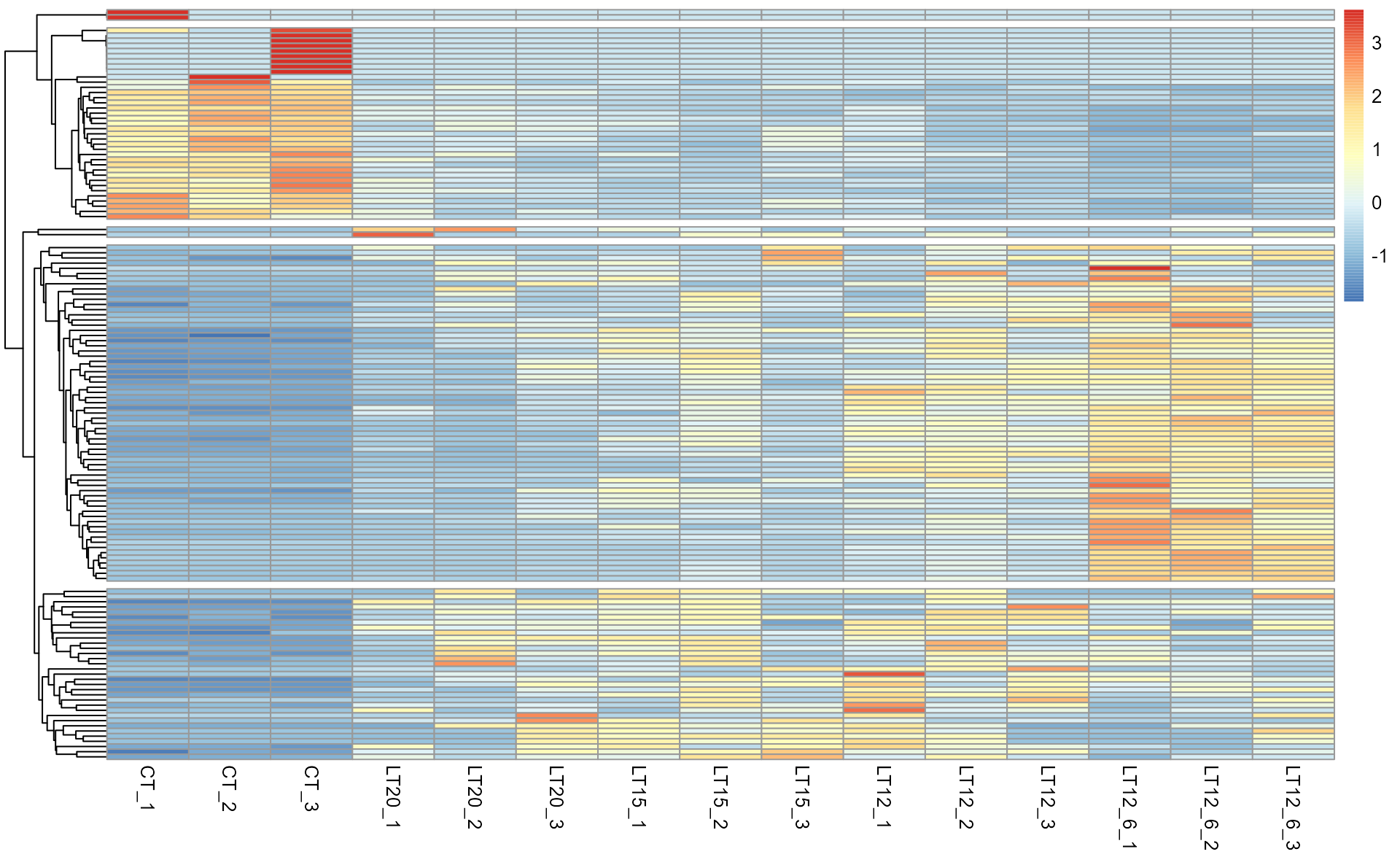
3.4.6 heatmap_cluster
Input Data: Dataframe: Shared DEGs of all paired comparisons in all samples expression dataframe of RNA-Seq. (1st-col: Genes, 2nd-col~: Samples).
Output Plot: Heatmap cluster plot for visualizing clustered gene expression data.
# 1. Load example datasets
data(gene_expression2)
head(gene_expression2)
#>   Genes  CT_1    CT_2  CT_3 LT20_1 LT20_2 LT20_3 LT15_1 LT15_2 LT15_3 LT12_1
#> 1 ACAA2 24.50   39.83 55.38 114.11 159.32  96.88 169.56 464.84 182.66 116.08
#> 2  ACAN 14.97   18.71 10.30  71.23 142.67 213.54 253.15 320.80 104.15 174.02
#> 3  ADH1  1.54    1.56  2.04  14.95  13.60  15.87  12.80  17.74   6.06  10.97
#> 4  AHSG  0.00 1911.99  0.00   0.00   0.00   0.00   0.00   0.00   0.00   0.00
#> 5 ALDH2  2.07    2.86  2.54   0.85   0.49   0.47   0.42   0.13   0.26   0.00
#> 6 AP1S3  6.62   14.59  9.30  24.90  33.94  23.19  24.00  36.08  27.40  24.06
#>   LT12_2 LT12_3 LT12_6_1 LT12_6_2 LT12_6_3
#> 1 497.29 464.48   471.43   693.62   229.77
#> 2 305.81 469.48  1291.90   991.90   966.77
#> 3  10.71  30.95     9.84    10.91     7.28
#> 4   0.00   0.00     0.00     0.00     0.00
#> 5   0.28   0.11     0.37     0.15     0.11
#> 6  38.74  34.54    62.72    41.36    28.75

# 2. Run heatmap_cluster function
heatmap_cluster(
  data = gene_expression2,
  dist_method = "euclidean",
  hc_method = "average",
  k_num = 5,
  show_rownames = FALSE,
  palette = "RdBu",
  cluster_pal = "Set1",
  border_color = "#ffffff",
  angle_col = 45,
  label_size = 10,
  base_size = 12,
  line_color = "#0000cd",
  line_alpha = 0.2,
  summary_color = "#0000cd",
  summary_alpha = 0.8
)


Get help using command ?TOmicsVis::heatmap_cluster or
reference page https://benben-miao.github.io/TOmicsVis/reference/heatmap_cluster.html.
# Get help with command in R console.
# ?TOmicsVis::heatmap_cluster
3.5 GO and KEGG Enrichment
3.5.1 go_enrich
Input Data: Dataframe: GO and KEGG annotation of background genes (1st-col: Genes, 2nd-col: biological_process, 3rd-col: cellular_component, 4th-col: molecular_function, 5th-col: kegg_pathway).
Output Table: GO enrichment analysis based on GO annotation results (None/Exist Reference Genome).
# 1. Load example datasets
data(gene_go_kegg)
head(gene_go_kegg)
#>        Genes
#> 1        FN1
#> 2 14-3-3ZETA
#> 3       A1I3
#> 4        A2M
#> 5       AARS
#> 6       ABAT
#>                                                                                                 biological_process
#> 1 GO:0003181(atrioventricular valve morphogenesis);GO:0003128(heart field specification);GO:0001756(somitogenesis)
#> 2                                                                                                             <NA>
#> 3                                                                                                             <NA>
#> 4                                                                                                             <NA>
#> 5                                                                           GO:0006419(alanyl-tRNA aminoacylation)
#> 6                                                            GO:0009448(gamma-aminobutyric acid metabolic process)
#>                 cellular_component
#> 1 GO:0005576(extracellular region)
#> 2                             <NA>
#> 3  GO:0005615(extracellular space)
#> 4  GO:0005615(extracellular space)
#> 5            GO:0005737(cytoplasm)
#> 6                             <NA>
#>                                                                                                       molecular_function
#> 1                                                                                                                   <NA>
#> 2                                                                            GO:0019904(protein domain specific binding)
#> 3                                                                           GO:0004866(endopeptidase inhibitor activity)
#> 4                                                                           GO:0004866(endopeptidase inhibitor activity)
#> 5 GO:0004813(alanine-tRNA ligase activity);GO:0005524(ATP binding);GO:0000049(tRNA binding);GO:0008270(zinc ion binding)
#> 6                              GO:0003867(4-aminobutyrate transaminase activity);GO:0030170(pyridoxal phosphate binding)
#>                                                                                                                                                                                                                                kegg_pathway
#> 1                                                                                                   ko04810(Regulation of actin cytoskeleton);ko04510(Focal adhesion);ko04151(PI3K-Akt signaling pathway);ko04512(ECM-receptor interaction)
#> 2 ko04110(Cell cycle);ko04114(Oocyte meiosis);ko04390(Hippo signaling pathway);ko04391(Hippo signaling pathway -fly);ko04013(MAPK signaling pathway - fly);ko04151(PI3K-Akt signaling pathway);ko04212(Longevity regulating pathway - worm)
#> 3                                                                                                                                                                                              ko04610(Complement and coagulation cascades)
#> 4                                                                                                                                                                                              ko04610(Complement and coagulation cascades)
#> 5                                                                                                                                                                                                      ko00970(Aminoacyl-tRNA biosynthesis)
#> 6         ko00250(Alanine, aspartate and glutamate metabolism);ko00280(Valine, leucine and isoleucine degradation);ko00650(Butanoate metabolism);ko00640(Propanoate metabolism);ko00410(beta-Alanine metabolism);ko04727(GABAergic synapse)

# 2. Run go_enrich analysis function
res <- go_enrich(
  go_anno = gene_go_kegg[,-5],
  degs_list = gene_go_kegg[100:200,1],
  padjust_method = "fdr",
  pvalue_cutoff = 0.05,
  qvalue_cutoff = 0.05
)
head(res)
#>           ID           ontology
#> 1 GO:0000221 cellular component
#> 2 GO:0000275 cellular component
#> 3 GO:0000276 cellular component
#> 4 GO:0000398 biological process
#> 5 GO:0000774 molecular function
#> 6 GO:0001671 molecular function
#>                                                                   Description
#> 1                       vacuolar proton-transporting V-type ATPase, V1 domain
#> 2  mitochondrial proton-transporting ATP synthase complex, catalytic core F(1
#> 3 mitochondrial proton-transporting ATP synthase complex, coupling factor F(o
#> 4                                              mRNA splicing, via spliceosome
#> 5                                  adenyl-nucleotide exchange factor activity
#> 6                                                   ATPase activator activity
#>   GeneRatio BgRatio RichFactor FoldEnrichment     zScore       pvalue
#> 1     1/101  1/1279 1.00000000     12.6633663  3.4151671 7.896794e-02
#> 2     1/101  1/1279 1.00000000     12.6633663  3.4151671 7.896794e-02
#> 3     6/101  6/1279 1.00000000     12.6633663  8.3818292 2.109128e-07
#> 4     1/101 14/1279 0.07142857      0.9045262 -0.1051372 6.858207e-01
#> 5     1/101  1/1279 1.00000000     12.6633663  3.4151671 7.896794e-02
#> 6     1/101  1/1279 1.00000000     12.6633663  3.4151671 7.896794e-02
#>       p.adjust       qvalue                                     geneID Count
#> 1 1.110997e-01 9.458955e-02                                    ATP6V1H     1
#> 2 1.110997e-01 9.458955e-02                                    ATP5F1E     1
#> 3 1.075656e-05 9.158058e-06 ATP5MC1/ATP5ME/ATP5MG/ATP5PB/ATP5PD/ATP5PF     6
#> 4 7.363549e-01 6.269275e-01                                      CDC40     1
#> 5 1.110997e-01 9.458955e-02                                       BAG2     1
#> 6 1.110997e-01 9.458955e-02                                     ATP1B1     1
Get help using command ?TOmicsVis::go_enrich or
reference page https://benben-miao.github.io/TOmicsVis/reference/go_enrich.html.
# Get help with command in R console.
# ?TOmicsVis::go_enrich
3.5.2 go_enrich_stat
Input Data: Dataframe: GO and KEGG annotation of background genes (1st-col: Genes, 2nd-col: biological_process, 3rd-col: cellular_component, 4th-col: molecular_function, 5th-col: kegg_pathway).
Output Plot: GO enrichment analysis and stat plot (None/Exist Reference Genome).
# 1. Load example datasets
data(gene_go_kegg)

# 2. Run go_enrich_stat analysis function
go_enrich_stat(
  go_anno = gene_go_kegg[,-5],
  degs_list = gene_go_kegg[100:200,1],
  padjust_method = "fdr",
  pvalue_cutoff = 0.05,
  qvalue_cutoff = 0.05,
  max_go_item = 15,
  strip_fill = "#CDCDCD",
  xtext_angle = 45,
  sci_fill_color = "Sci_AAAS",
  sci_fill_alpha = 0.8,
  ggTheme = "theme_publication"
)
Get help using command ?TOmicsVis::go_enrich_stat or
reference page https://benben-miao.github.io/TOmicsVis/reference/go_enrich_stat.html.
# Get help with command in R console.
# ?TOmicsVis::go_enrich_stat
3.5.3 go_enrich_bar
Input Data: Dataframe: GO and KEGG annotation of background genes (1st-col: Genes, 2nd-col: biological_process, 3rd-col: cellular_component, 4th-col: molecular_function, 5th-col: kegg_pathway).
Output Plot: GO enrichment analysis and bar plot (None/Exist Reference Genome).
# 1. Load example datasets
data(gene_go_kegg)

# 2. Run go_enrich_bar analysis function
go_enrich_bar(
  go_anno = gene_go_kegg[,-5],
  degs_list = gene_go_kegg[100:200,1],
  padjust_method = "fdr",
  pvalue_cutoff = 0.05,
  qvalue_cutoff = 0.05,
  sign_by = "p.adjust",
  category_num = 30,
  font_size = 12,
  low_color = "#ff0000aa",
  high_color = "#008800aa",
  ggTheme = "theme_publication"
)
#> Scale for fill is already present.
#> Adding another scale for fill, which will replace the existing scale.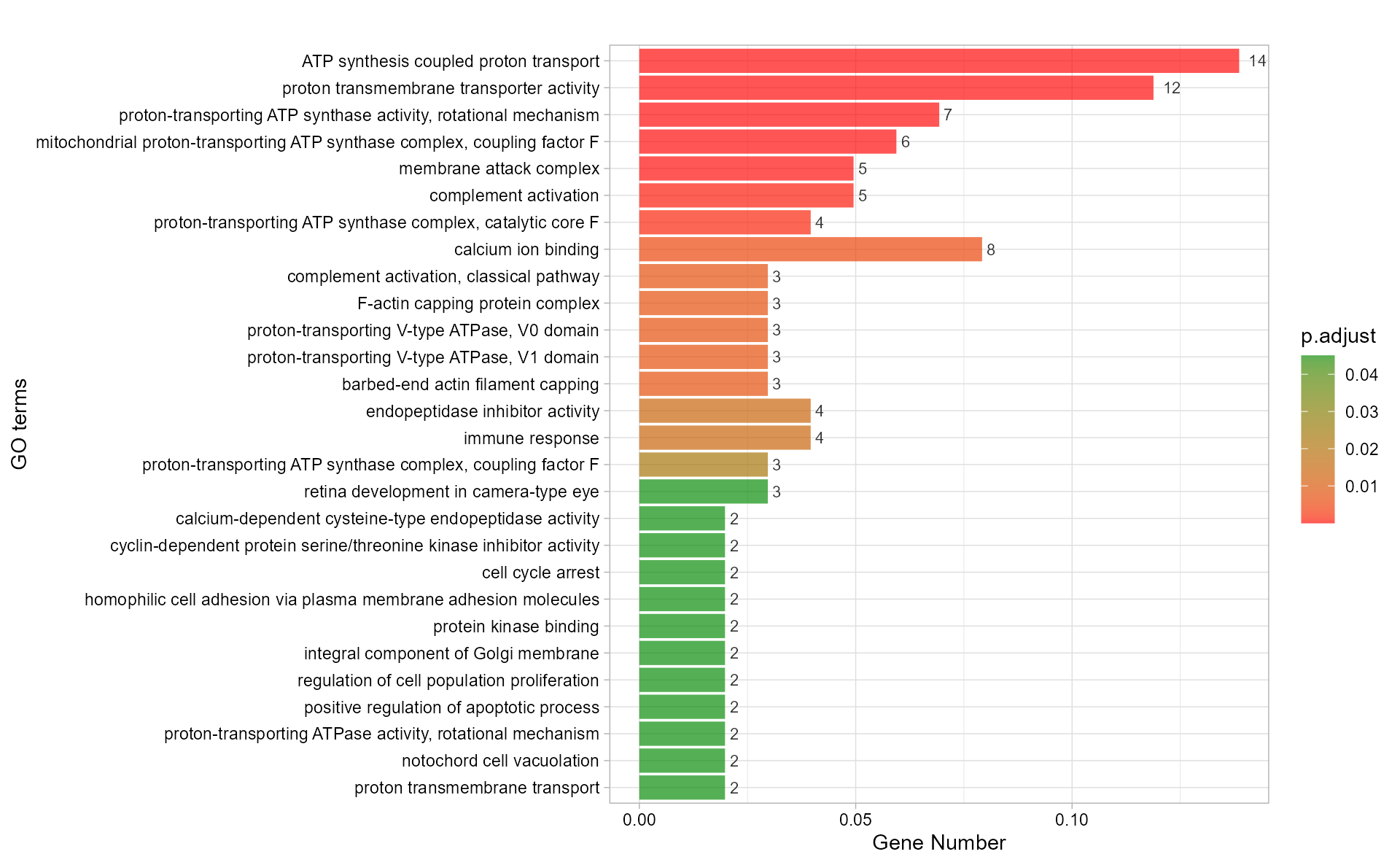
Get help using command ?TOmicsVis::go_enrich_bar or
reference page https://benben-miao.github.io/TOmicsVis/reference/go_enrich_bar.html.
# Get help with command in R console.
# ?TOmicsVis::go_enrich_bar
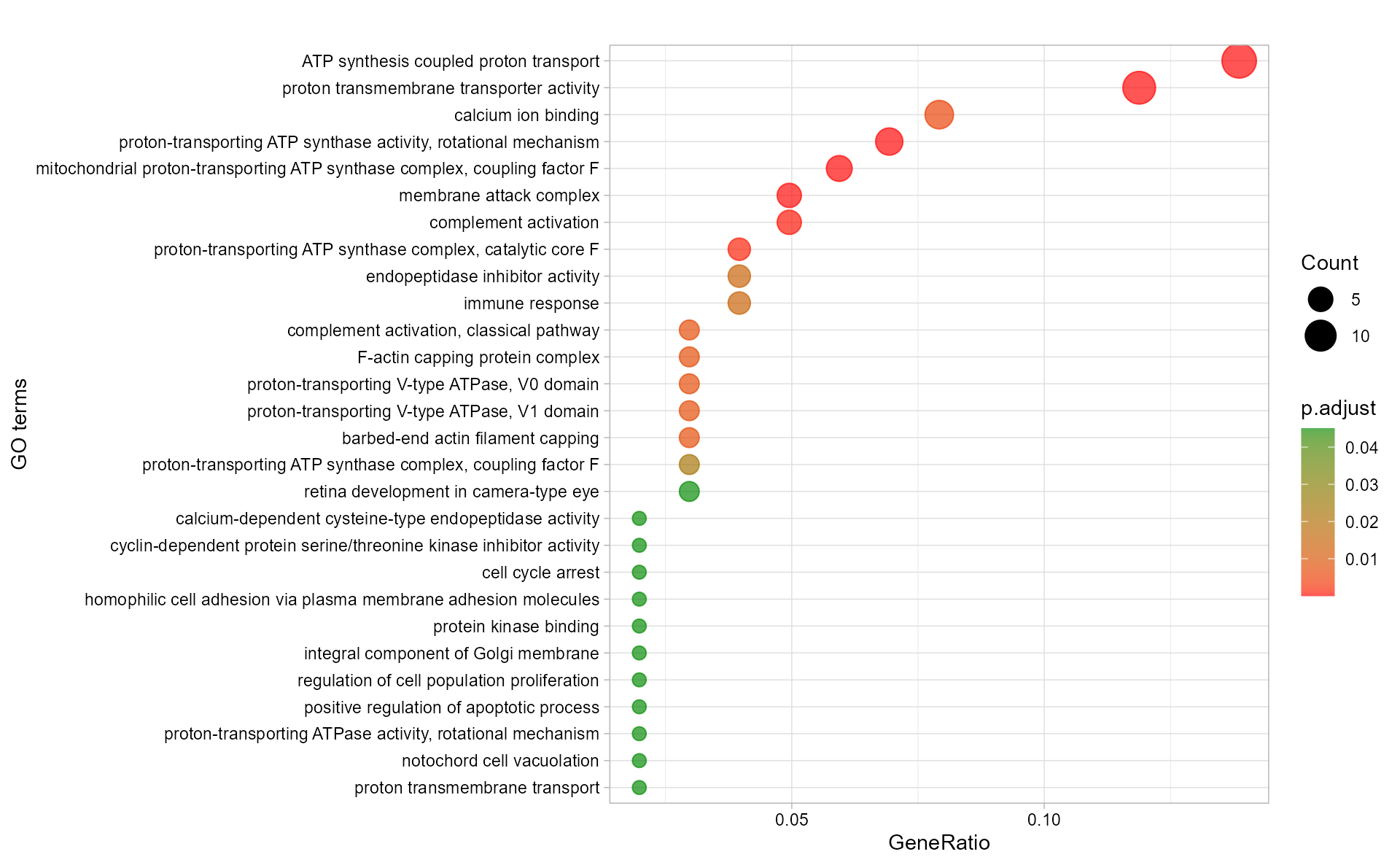
3.5.4 go_enrich_dot
Input Data: Dataframe: GO and KEGG annotation of background genes (1st-col: Genes, 2nd-col: biological_process, 3rd-col: cellular_component, 4th-col: molecular_function, 5th-col: kegg_pathway).
Output Plot: GO enrichment analysis and dot plot (None/Exist Reference Genome).
# 1. Load example datasets
data(gene_go_kegg)

# 2. Run go_enrich_dot analysis function
go_enrich_dot(
  go_anno = gene_go_kegg[,-5],
  degs_list = gene_go_kegg[100:200,1],
  padjust_method = "fdr",
  pvalue_cutoff = 0.05,
  qvalue_cutoff = 0.05,
  sign_by = "p.adjust",
  category_num = 30,
  font_size = 12,
  low_color = "#ff0000aa",
  high_color = "#008800aa",
  ggTheme = "theme_publication"
)
Get help using command ?TOmicsVis::go_enrich_dot or
reference page https://benben-miao.github.io/TOmicsVis/reference/go_enrich_dot.html.
# Get help with command in R console.
# ?TOmicsVis::go_enrich_dot
3.5.5 go_enrich_net
Input Data: Dataframe: GO and KEGG annotation of background genes (1st-col: Genes, 2nd-col: biological_process, 3rd-col: cellular_component, 4th-col: molecular_function, 5th-col: kegg_pathway).
Output Plot: GO enrichment analysis and net plot (None/Exist Reference Genome).
# 1. Load example datasets
data(gene_go_kegg)

# 2. Run go_enrich_net analysis function
go_enrich_net(
  go_anno = gene_go_kegg[,-5],
  degs_list = gene_go_kegg[100:200,1],
  padjust_method = "fdr",
  pvalue_cutoff = 0.05,
  qvalue_cutoff = 0.05,
  category_num = 20,
  net_layout = "circle",
  low_color = "#ff0000aa",
  high_color = "#008800aa"
)
Get help using command ?TOmicsVis::go_enrich_net or
reference page https://benben-miao.github.io/TOmicsVis/reference/go_enrich_net.html.
# Get help with command in R console.
# ?TOmicsVis::go_enrich_net
3.5.6 kegg_enrich
Input Data: Dataframe: GO and KEGG annotation of background genes (1st-col: Genes, 2nd-col: biological_process, 3rd-col: cellular_component, 4th-col: molecular_function, 5th-col: kegg_pathway).
Output Plot: GO enrichment analysis based on GO annotation results (None/Exist Reference Genome).
# 1. Load example datasets
data(gene_go_kegg)
head(gene_go_kegg)
#>        Genes
#> 1        FN1
#> 2 14-3-3ZETA
#> 3       A1I3
#> 4        A2M
#> 5       AARS
#> 6       ABAT
#>                                                                                                 biological_process
#> 1 GO:0003181(atrioventricular valve morphogenesis);GO:0003128(heart field specification);GO:0001756(somitogenesis)
#> 2                                                                                                             <NA>
#> 3                                                                                                             <NA>
#> 4                                                                                                             <NA>
#> 5                                                                           GO:0006419(alanyl-tRNA aminoacylation)
#> 6                                                            GO:0009448(gamma-aminobutyric acid metabolic process)
#>                 cellular_component
#> 1 GO:0005576(extracellular region)
#> 2                             <NA>
#> 3  GO:0005615(extracellular space)
#> 4  GO:0005615(extracellular space)
#> 5            GO:0005737(cytoplasm)
#> 6                             <NA>
#>                                                                                                       molecular_function
#> 1                                                                                                                   <NA>
#> 2                                                                            GO:0019904(protein domain specific binding)
#> 3                                                                           GO:0004866(endopeptidase inhibitor activity)
#> 4                                                                           GO:0004866(endopeptidase inhibitor activity)
#> 5 GO:0004813(alanine-tRNA ligase activity);GO:0005524(ATP binding);GO:0000049(tRNA binding);GO:0008270(zinc ion binding)
#> 6                              GO:0003867(4-aminobutyrate transaminase activity);GO:0030170(pyridoxal phosphate binding)
#>                                                                                                                                                                                                                                kegg_pathway
#> 1                                                                                                   ko04810(Regulation of actin cytoskeleton);ko04510(Focal adhesion);ko04151(PI3K-Akt signaling pathway);ko04512(ECM-receptor interaction)
#> 2 ko04110(Cell cycle);ko04114(Oocyte meiosis);ko04390(Hippo signaling pathway);ko04391(Hippo signaling pathway -fly);ko04013(MAPK signaling pathway - fly);ko04151(PI3K-Akt signaling pathway);ko04212(Longevity regulating pathway - worm)
#> 3                                                                                                                                                                                              ko04610(Complement and coagulation cascades)
#> 4                                                                                                                                                                                              ko04610(Complement and coagulation cascades)
#> 5                                                                                                                                                                                                      ko00970(Aminoacyl-tRNA biosynthesis)
#> 6         ko00250(Alanine, aspartate and glutamate metabolism);ko00280(Valine, leucine and isoleucine degradation);ko00650(Butanoate metabolism);ko00640(Propanoate metabolism);ko00410(beta-Alanine metabolism);ko04727(GABAergic synapse)

# 2. Run go_enrich analysis function
res <- kegg_enrich(
  kegg_anno = gene_go_kegg[,c(1,5)],
  degs_list = gene_go_kegg[100:200,1],
  padjust_method = "fdr",
  pvalue_cutoff = 0.05,
  qvalue_cutoff = 0.05
)
head(res)
#>              ID                         Description GeneRatio BgRatio
#> ko04966 ko04966      Collecting duct acid secretion     7/101  7/1279
#> ko00190 ko00190           Oxidative phosphorylation    23/101 88/1279
#> ko04721 ko04721              Synaptic vesicle cycle     8/101 13/1279
#> ko04610 ko04610 Complement and coagulation cascades    13/101 43/1279
#> ko04145 ko04145                           Phagosome    11/101 33/1279
#> ko04971 ko04971              Gastric acid secretion     4/101  4/1279
#>         RichFactor FoldEnrichment   zScore       pvalue     p.adjust
#> ko04966  1.0000000      12.663366 9.056968 1.573976e-08 2.030430e-06
#> ko00190  0.2613636       3.309743 6.572077 5.232645e-08 3.375056e-06
#> ko04721  0.6153846       7.792841 7.205427 1.069634e-06 4.599427e-05
#> ko04610  0.3023256       3.828460 5.522407 1.078094e-05 3.476853e-04
#> ko04145  0.3333333       4.221122 5.487299 1.941460e-05 5.008968e-04
#> ko04971  1.0000000      12.663366 6.838365 3.679084e-05 7.910030e-04
#>               qvalue
#> ko04966 1.723090e-06
#> ko00190 2.864185e-06
#> ko04721 3.903227e-05
#> ko04610 2.950573e-04
#> ko04145 4.250776e-04
#> ko04971 6.712714e-04
#>                                                                                                                                                                                        geneID
#> ko04966                                                                                                                              ATP6V0C/ATP6V0E1/ATP6V1B2/ATP6V1C1A/ATP6V1F/ATP6V1G1/CA1
#> ko00190 ATP5F1A/ATP5F1B/ATP5F1C/ATP5F1D/ATP5F1E/ATP5MC1/ATP5MC2/ATP5MC3/ATP5ME/ATP5MF/ATP5MG/ATP5PB/ATP5PD/ATP5PF/ATP5PO/ATP6V0B/ATP6V0C/ATP6V0E1/ATP6V1B2/ATP6V1C1A/ATP6V1F/ATP6V1G1/ATP6V1H
#> ko04721                                                                                                                  ATP6V0B/ATP6V0C/ATP6V0E1/ATP6V1B2/ATP6V1C1A/ATP6V1F/ATP6V1G1/ATP6V1H
#> ko04610                                                                                                                                       C1QC/C1S/C3/C4/C4A/C5/C6/C7/C8A/C8B/C8G/C9/CD59
#> ko04145                                                                                                     ATP6V0B/ATP6V0C/ATP6V0E1/ATP6V1B2/ATP6V1C1A/ATP6V1F/ATP6V1G1/ATP6V1H/C3/CALR/CANX
#> ko04971                                                                                                                                                               ATP1B1/CA1/CALM1/CAMK2D
#>         Count
#> ko04966     7
#> ko00190    23
#> ko04721     8
#> ko04610    13
#> ko04145    11
#> ko04971     4
Get help using command ?TOmicsVis::kegg_enrich or
reference page https://benben-miao.github.io/TOmicsVis/reference/kegg_enrich.html.
# Get help with command in R console.
# ?TOmicsVis::kegg_enrich
3.5.7 kegg_enrich_bar
Input Data: Dataframe: GO and KEGG annotation of background genes (1st-col: Genes, 2nd-col: biological_process, 3rd-col: cellular_component, 4th-col: molecular_function, 5th-col: kegg_pathway).
Output Plot: KEGG enrichment analysis and bar plot (None/Exist Reference Genome).
# 1. Load example datasets
data(gene_go_kegg)

# 2. Run kegg_enrich_bar analysis function
kegg_enrich_bar(
  kegg_anno = gene_go_kegg[,c(1,5)],
  degs_list = gene_go_kegg[100:200,1],
  padjust_method = "fdr",
  pvalue_cutoff = 0.05,
  qvalue_cutoff = 0.05,
  sign_by = "p.adjust",
  category_num = 30,
  font_size = 12,
  low_color = "#ff0000aa",
  high_color = "#008800aa",
  ggTheme = "theme_publication"
)
#> Scale for fill is already present.
#> Adding another scale for fill, which will replace the existing scale.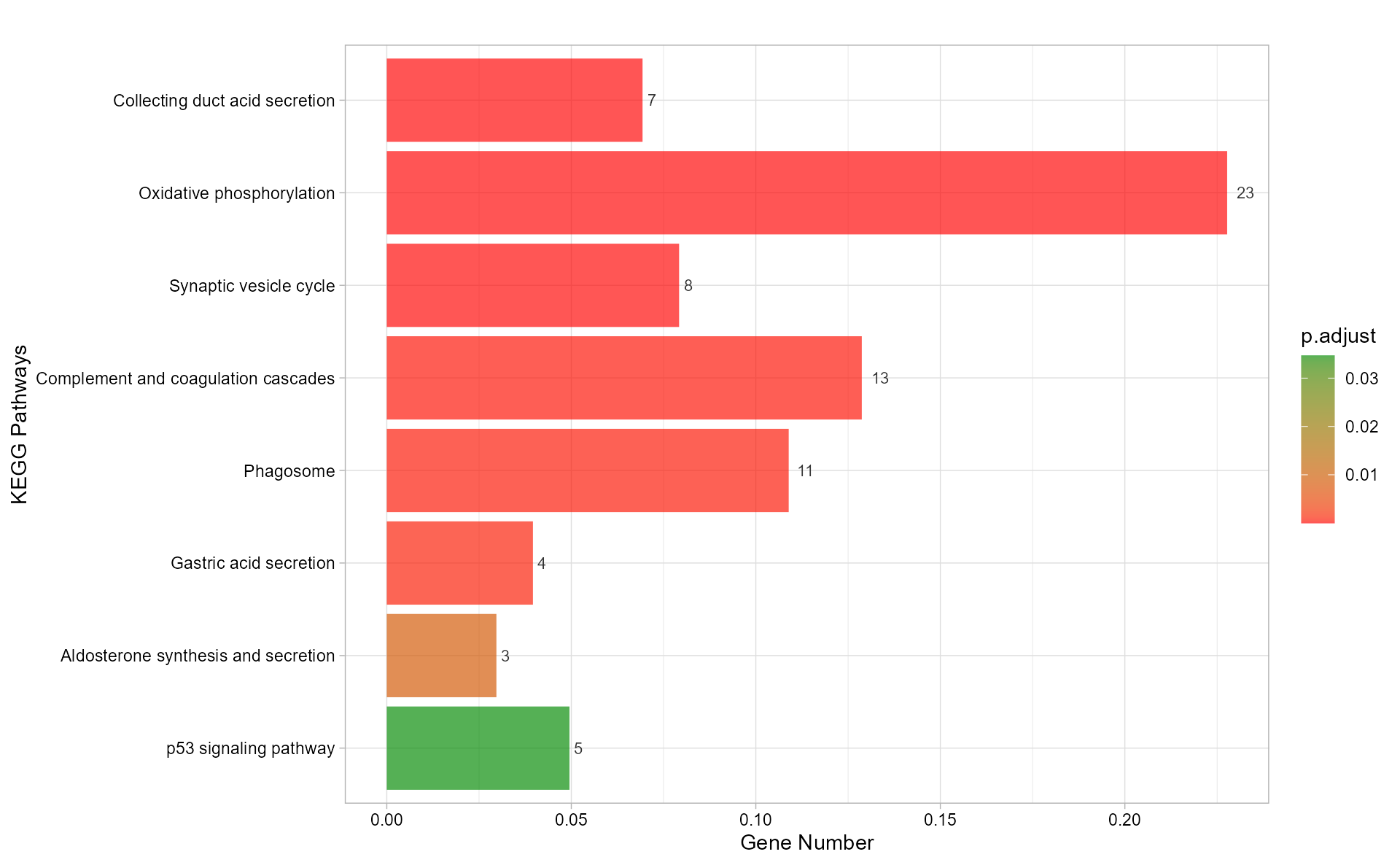
Get help using command ?TOmicsVis::kegg_enrich_bar or
reference page https://benben-miao.github.io/TOmicsVis/reference/kegg_enrich_bar.html.
# Get help with command in R console.
# ?TOmicsVis::kegg_enrich_bar
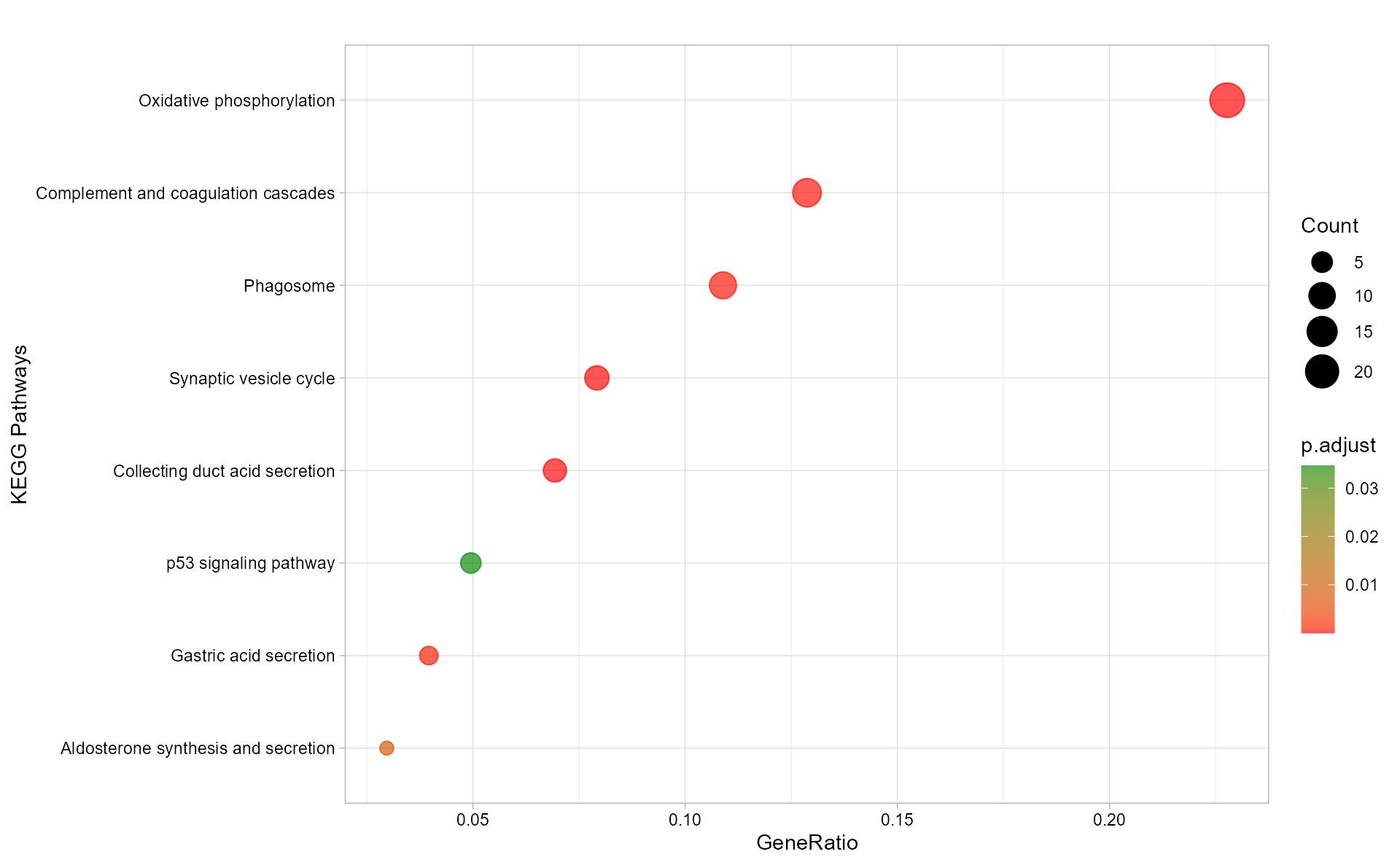
3.5.8 kegg_enrich_dot
Input Data: Dataframe: GO and KEGG annotation of background genes (1st-col: Genes, 2nd-col: biological_process, 3rd-col: cellular_component, 4th-col: molecular_function, 5th-col: kegg_pathway).
Output Plot: KEGG enrichment analysis and dot plot (None/Exist Reference Genome).
# 1. Load example datasets
data(gene_go_kegg)

# 2. Run kegg_enrich_dot analysis function
kegg_enrich_dot(
  kegg_anno = gene_go_kegg[,c(1,5)],
  degs_list = gene_go_kegg[100:200,1],
  padjust_method = "fdr",
  pvalue_cutoff = 0.05,
  qvalue_cutoff = 0.05,
  sign_by = "p.adjust",
  category_num = 30,
  font_size = 12,
  low_color = "#ff0000aa",
  high_color = "#008800aa",
  ggTheme = "theme_publication"
)
Get help using command ?TOmicsVis::kegg_enrich_dot or
reference page https://benben-miao.github.io/TOmicsVis/reference/kegg_enrich_dot.html.
# Get help with command in R console.
# ?TOmicsVis::kegg_enrich_dot
3.5.9 kegg_enrich_net
Input Data: Dataframe: GO and KEGG annotation of background genes (1st-col: Genes, 2nd-col: biological_process, 3rd-col: cellular_component, 4th-col: molecular_function, 5th-col: kegg_pathway).
Output Plot: KEGG enrichment analysis and net plot (None/Exist Reference Genome).
# 1. Load example datasets
data(gene_go_kegg)

# 2. Run kegg_enrich_net analysis function
kegg_enrich_net(
  kegg_anno = gene_go_kegg[,c(1,5)],
  degs_list = gene_go_kegg[100:200,1],
  padjust_method = "fdr",
  pvalue_cutoff = 0.05,
  qvalue_cutoff = 0.05,
  category_num = 20,
  net_layout = "circle",
  low_color = "#ff0000aa",
  high_color = "#008800aa"
)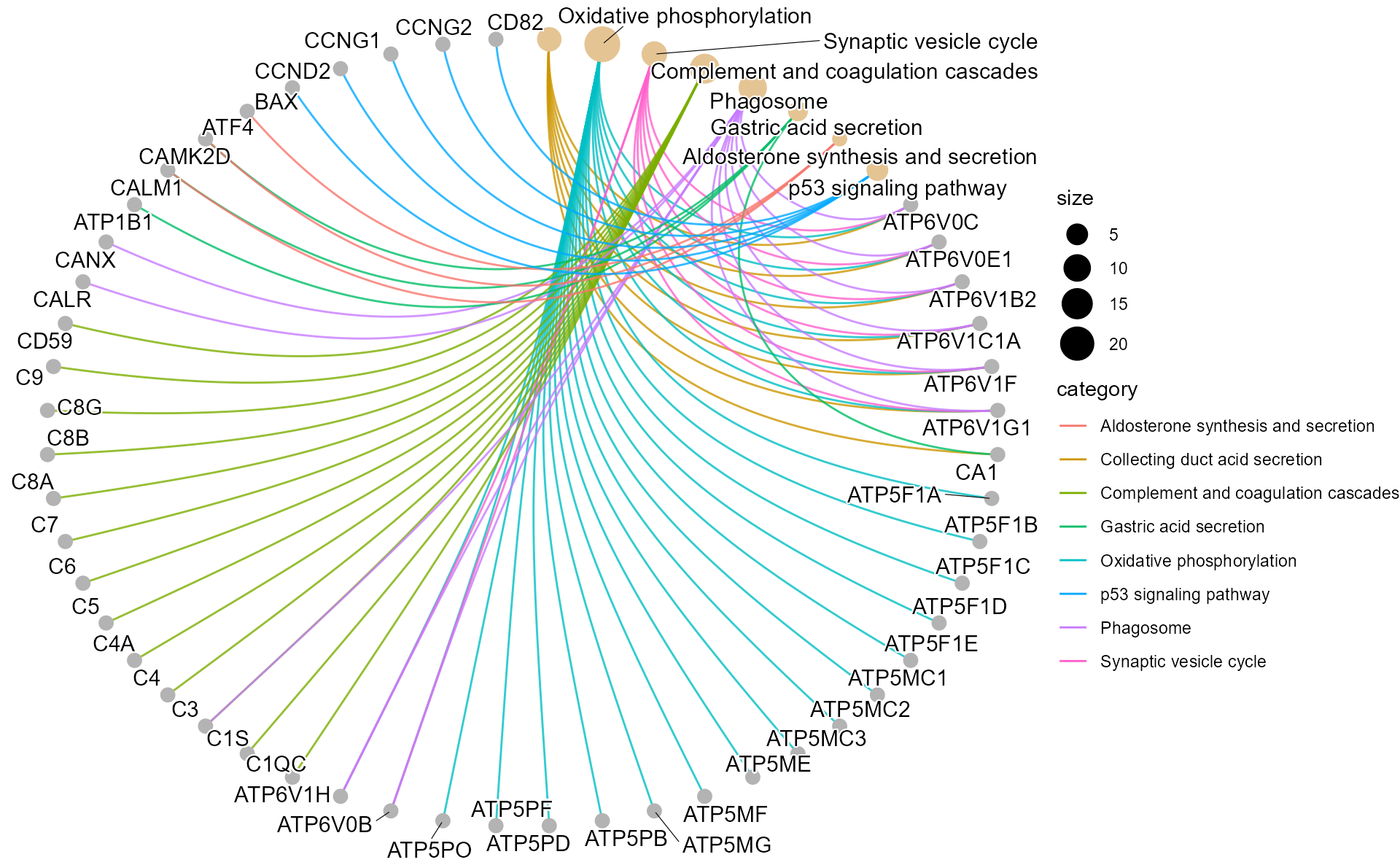
Get help using command ?TOmicsVis::kegg_enrich_net or
reference page https://benben-miao.github.io/TOmicsVis/reference/kegg_enrich_net.html.
# Get help with command in R console.
# ?TOmicsVis::kegg_enrich_net
3.6 Tables Operations
3.6.1 table_split
Input Data: Dataframe: GO and KEGG annotation of background genes (1st-col: Genes, 2nd-col: biological_process, 3rd-col: cellular_component, 4th-col: molecular_function, 5th-col: kegg_pathway).
Output Table: Table split used for splitting a grouped column to multiple columns.
# 1. Load example datasets
data(gene_go_kegg2)
head(gene_go_kegg2)
#>        Genes
#> 1        FN1
#> 2 14-3-3ZETA
#> 3       A1I3
#> 4        A2M
#> 5       AARS
#> 6       ABAT
#>                                                                                                                                                                                                                                kegg_pathway
#> 1                                                                                                   ko04810(Regulation of actin cytoskeleton);ko04510(Focal adhesion);ko04151(PI3K-Akt signaling pathway);ko04512(ECM-receptor interaction)
#> 2 ko04110(Cell cycle);ko04114(Oocyte meiosis);ko04390(Hippo signaling pathway);ko04391(Hippo signaling pathway -fly);ko04013(MAPK signaling pathway - fly);ko04151(PI3K-Akt signaling pathway);ko04212(Longevity regulating pathway - worm)
#> 3                                                                                                                                                                                              ko04610(Complement and coagulation cascades)
#> 4                                                                                                                                                                                              ko04610(Complement and coagulation cascades)
#> 5                                                                                                                                                                                                      ko00970(Aminoacyl-tRNA biosynthesis)
#> 6         ko00250(Alanine, aspartate and glutamate metabolism);ko00280(Valine, leucine and isoleucine degradation);ko00650(Butanoate metabolism);ko00640(Propanoate metabolism);ko00410(beta-Alanine metabolism);ko04727(GABAergic synapse)
#>          go_category
#> 1 biological_process
#> 2 biological_process
#> 3 biological_process
#> 4 biological_process
#> 5 biological_process
#> 6 biological_process
#>                                                                                                            go_term
#> 1 GO:0003181(atrioventricular valve morphogenesis);GO:0003128(heart field specification);GO:0001756(somitogenesis)
#> 2                                                                                                             <NA>
#> 3                                                                                                             <NA>
#> 4                                                                                                             <NA>
#> 5                                                                           GO:0006419(alanyl-tRNA aminoacylation)
#> 6                                                            GO:0009448(gamma-aminobutyric acid metabolic process)

# 2. Run table_split function
res <- table_split(
  data = gene_go_kegg2,
  grouped_var = "go_category",
  value_var = "go_term",
  miss_drop = TRUE
)
head(res)
#> # A tibble: 6 × 5
#>   Genes kegg_pathway    biological_process cellular_component molecular_function
#>   <chr> <chr>           <chr>              <chr>              <chr>
#> 1 FN1   ko04810(Regula… GO:0003181(atriov… GO:0005576(extrac… NA
#> 2 AARS  ko00970(Aminoa… GO:0006419(alanyl… GO:0005737(cytopl… GO:0004813(alanin…
#> 3 ABAT  ko00250(Alanin… GO:0009448(gamma-… NA                 GO:0003867(4-amin…
#> 4 ACADL ko00071(Fatty … GO:0042758(long-c… NA                 GO:0050660(flavin…
#> 5 ACADM ko00280(Valine… GO:0006635(fatty … GO:0005739(mitoch… GO:0050660(flavin…
#> 6 ACMSD ko00380(Trypto… GO:1904985(negati… GO:0005829(cytoso… GO:0001760(aminoc…
Get help using command ?TOmicsVis::table_split or
reference page https://benben-miao.github.io/TOmicsVis/reference/table_split.html.
# Get help with command in R console.
# ?TOmicsVis::table_split
3.6.2 table_merge
Input Data: Dataframe: GO and KEGG annotation of background genes (1st-col: Genes, 2nd-col: biological_process, 3rd-col: cellular_component, 4th-col: molecular_function, 5th-col: kegg_pathway).
Output Table: Table merge used to merge multiple variables to on variable.
# 1. Load example datasets
data(gene_go_kegg)
head(gene_go_kegg)
#>        Genes
#> 1        FN1
#> 2 14-3-3ZETA
#> 3       A1I3
#> 4        A2M
#> 5       AARS
#> 6       ABAT
#>                                                                                                 biological_process
#> 1 GO:0003181(atrioventricular valve morphogenesis);GO:0003128(heart field specification);GO:0001756(somitogenesis)
#> 2                                                                                                             <NA>
#> 3                                                                                                             <NA>
#> 4                                                                                                             <NA>
#> 5                                                                           GO:0006419(alanyl-tRNA aminoacylation)
#> 6                                                            GO:0009448(gamma-aminobutyric acid metabolic process)
#>                 cellular_component
#> 1 GO:0005576(extracellular region)
#> 2                             <NA>
#> 3  GO:0005615(extracellular space)
#> 4  GO:0005615(extracellular space)
#> 5            GO:0005737(cytoplasm)
#> 6                             <NA>
#>                                                                                                       molecular_function
#> 1                                                                                                                   <NA>
#> 2                                                                            GO:0019904(protein domain specific binding)
#> 3                                                                           GO:0004866(endopeptidase inhibitor activity)
#> 4                                                                           GO:0004866(endopeptidase inhibitor activity)
#> 5 GO:0004813(alanine-tRNA ligase activity);GO:0005524(ATP binding);GO:0000049(tRNA binding);GO:0008270(zinc ion binding)
#> 6                              GO:0003867(4-aminobutyrate transaminase activity);GO:0030170(pyridoxal phosphate binding)
#>                                                                                                                                                                                                                                kegg_pathway
#> 1                                                                                                   ko04810(Regulation of actin cytoskeleton);ko04510(Focal adhesion);ko04151(PI3K-Akt signaling pathway);ko04512(ECM-receptor interaction)
#> 2 ko04110(Cell cycle);ko04114(Oocyte meiosis);ko04390(Hippo signaling pathway);ko04391(Hippo signaling pathway -fly);ko04013(MAPK signaling pathway - fly);ko04151(PI3K-Akt signaling pathway);ko04212(Longevity regulating pathway - worm)
#> 3                                                                                                                                                                                              ko04610(Complement and coagulation cascades)
#> 4                                                                                                                                                                                              ko04610(Complement and coagulation cascades)
#> 5                                                                                                                                                                                                      ko00970(Aminoacyl-tRNA biosynthesis)
#> 6         ko00250(Alanine, aspartate and glutamate metabolism);ko00280(Valine, leucine and isoleucine degradation);ko00650(Butanoate metabolism);ko00640(Propanoate metabolism);ko00410(beta-Alanine metabolism);ko04727(GABAergic synapse)

# 2. Run function
res <- table_merge(
  data = gene_go_kegg,
  merge_vars = c("biological_process", "cellular_component", "molecular_function"),
  new_var = "go_category",
  new_value = "go_term",
  na_remove = FALSE
)
head(res)
#> # A tibble: 6 × 4
#>   Genes      kegg_pathway                                    go_category go_term
#>   <chr>      <chr>                                           <chr>       <chr>
#> 1 FN1        ko04810(Regulation of actin cytoskeleton);ko04… biological… GO:000…
#> 2 FN1        ko04810(Regulation of actin cytoskeleton);ko04… cellular_c… GO:000…
#> 3 FN1        ko04810(Regulation of actin cytoskeleton);ko04… molecular_… NA
#> 4 14-3-3ZETA ko04110(Cell cycle);ko04114(Oocyte meiosis);ko… biological… NA
#> 5 14-3-3ZETA ko04110(Cell cycle);ko04114(Oocyte meiosis);ko… cellular_c… NA
#> 6 14-3-3ZETA ko04110(Cell cycle);ko04114(Oocyte meiosis);ko… molecular_… GO:001…
Get help using command ?TOmicsVis::table_merge or
reference page https://benben-miao.github.io/TOmicsVis/reference/table_merge.html.
# Get help with command in R console.
# ?TOmicsVis::table_merge
3.6.3 table_filter
Input Data: Dataframe: GO and KEGG annotation of background genes (1st-col: Genes, 2nd-col: biological_process, 3rd-col: cellular_component, 4th-col: molecular_function, 5th-col: kegg_pathway).
Output Table: Table filter used to filter row by column condition.
# 1. Load example datasets
data(traits_sex)
head(traits_sex)
#>   Value Traits    Sex
#> 1 36.74 Weight Female
#> 2 38.54 Weight Female
#> 3 44.91 Weight Female
#> 4 43.53 Weight Female
#> 5 39.03 Weight Female
#> 6 26.01 Weight Female

# 2. Run function
res <- table_filter(
    data = traits_sex,
    Sex == "Male" & Traits == "Weight" & Value > 40
    )
head(res)
#>   Value Traits  Sex
#> 1 48.06 Weight Male
#> 2 42.74 Weight Male
#> 3 45.25 Weight Male
#> 4 44.95 Weight Male
#> 5 43.21 Weight Male
#> 6 40.02 Weight Male
Get help using command ?TOmicsVis::table_filter or
reference page https://benben-miao.github.io/TOmicsVis/reference/table_filter.html.
# Get help with command in R console.
# ?TOmicsVis::table_filter
3.6.4 table_cross
Input Data1: Dataframe: Shared DEGs of all paired comparisons in all samples expression dataframe of RNA-Seq. (1st-col: Genes, 2nd-col~: Samples).
Input Data2: Dataframe: GO and KEGG annotation of background genes (1st-col: Genes, 2nd-col: biological_process, 3rd-col: cellular_component, 4th-col: molecular_function, 5th-col: kegg_pathway).
Output Plot: Table cross used to cross search and merge results in two tables.
# 1. Load example datasets
data(gene_expression2)
head(gene_expression2)
#>   Genes  CT_1    CT_2  CT_3 LT20_1 LT20_2 LT20_3 LT15_1 LT15_2 LT15_3 LT12_1
#> 1 ACAA2 24.50   39.83 55.38 114.11 159.32  96.88 169.56 464.84 182.66 116.08
#> 2  ACAN 14.97   18.71 10.30  71.23 142.67 213.54 253.15 320.80 104.15 174.02
#> 3  ADH1  1.54    1.56  2.04  14.95  13.60  15.87  12.80  17.74   6.06  10.97
#> 4  AHSG  0.00 1911.99  0.00   0.00   0.00   0.00   0.00   0.00   0.00   0.00
#> 5 ALDH2  2.07    2.86  2.54   0.85   0.49   0.47   0.42   0.13   0.26   0.00
#> 6 AP1S3  6.62   14.59  9.30  24.90  33.94  23.19  24.00  36.08  27.40  24.06
#>   LT12_2 LT12_3 LT12_6_1 LT12_6_2 LT12_6_3
#> 1 497.29 464.48   471.43   693.62   229.77
#> 2 305.81 469.48  1291.90   991.90   966.77
#> 3  10.71  30.95     9.84    10.91     7.28
#> 4   0.00   0.00     0.00     0.00     0.00
#> 5   0.28   0.11     0.37     0.15     0.11
#> 6  38.74  34.54    62.72    41.36    28.75

data(gene_go_kegg)
head(gene_go_kegg)
#>        Genes
#> 1        FN1
#> 2 14-3-3ZETA
#> 3       A1I3
#> 4        A2M
#> 5       AARS
#> 6       ABAT
#>                                                                                                 biological_process
#> 1 GO:0003181(atrioventricular valve morphogenesis);GO:0003128(heart field specification);GO:0001756(somitogenesis)
#> 2                                                                                                             <NA>
#> 3                                                                                                             <NA>
#> 4                                                                                                             <NA>
#> 5                                                                           GO:0006419(alanyl-tRNA aminoacylation)
#> 6                                                            GO:0009448(gamma-aminobutyric acid metabolic process)
#>                 cellular_component
#> 1 GO:0005576(extracellular region)
#> 2                             <NA>
#> 3  GO:0005615(extracellular space)
#> 4  GO:0005615(extracellular space)
#> 5            GO:0005737(cytoplasm)
#> 6                             <NA>
#>                                                                                                       molecular_function
#> 1                                                                                                                   <NA>
#> 2                                                                            GO:0019904(protein domain specific binding)
#> 3                                                                           GO:0004866(endopeptidase inhibitor activity)
#> 4                                                                           GO:0004866(endopeptidase inhibitor activity)
#> 5 GO:0004813(alanine-tRNA ligase activity);GO:0005524(ATP binding);GO:0000049(tRNA binding);GO:0008270(zinc ion binding)
#> 6                              GO:0003867(4-aminobutyrate transaminase activity);GO:0030170(pyridoxal phosphate binding)
#>                                                                                                                                                                                                                                kegg_pathway
#> 1                                                                                                   ko04810(Regulation of actin cytoskeleton);ko04510(Focal adhesion);ko04151(PI3K-Akt signaling pathway);ko04512(ECM-receptor interaction)
#> 2 ko04110(Cell cycle);ko04114(Oocyte meiosis);ko04390(Hippo signaling pathway);ko04391(Hippo signaling pathway -fly);ko04013(MAPK signaling pathway - fly);ko04151(PI3K-Akt signaling pathway);ko04212(Longevity regulating pathway - worm)
#> 3                                                                                                                                                                                              ko04610(Complement and coagulation cascades)
#> 4                                                                                                                                                                                              ko04610(Complement and coagulation cascades)
#> 5                                                                                                                                                                                                      ko00970(Aminoacyl-tRNA biosynthesis)
#> 6         ko00250(Alanine, aspartate and glutamate metabolism);ko00280(Valine, leucine and isoleucine degradation);ko00650(Butanoate metabolism);ko00640(Propanoate metabolism);ko00410(beta-Alanine metabolism);ko04727(GABAergic synapse)

# 2. Run function
res <- table_cross(
  data1 = gene_expression2,
  data2 = gene_go_kegg,
  inter_var = "Genes",
  left_index = TRUE,
  right_index = TRUE
)
head(res)
#>        Genes CT_1 CT_2 CT_3 LT20_1 LT20_2 LT20_3 LT15_1 LT15_2 LT15_3 LT12_1
#> 1 14-3-3ZETA   NA   NA   NA     NA     NA     NA     NA     NA     NA     NA
#> 2       A1I3   NA   NA   NA     NA     NA     NA     NA     NA     NA     NA
#> 3        A2M   NA   NA   NA     NA     NA     NA     NA     NA     NA     NA
#> 4       AARS   NA   NA   NA     NA     NA     NA     NA     NA     NA     NA
#> 5       ABAT   NA   NA   NA     NA     NA     NA     NA     NA     NA     NA
#> 6      ABCB7   NA   NA   NA     NA     NA     NA     NA     NA     NA     NA
#>   LT12_2 LT12_3 LT12_6_1 LT12_6_2 LT12_6_3
#> 1     NA     NA       NA       NA       NA
#> 2     NA     NA       NA       NA       NA
#> 3     NA     NA       NA       NA       NA
#> 4     NA     NA       NA       NA       NA
#> 5     NA     NA       NA       NA       NA
#> 6     NA     NA       NA       NA       NA
#>                                      biological_process
#> 1                                                  <NA>
#> 2                                                  <NA>
#> 3                                                  <NA>
#> 4                GO:0006419(alanyl-tRNA aminoacylation)
#> 5 GO:0009448(gamma-aminobutyric acid metabolic process)
#> 6                                                  <NA>
#>                           cellular_component
#> 1                                       <NA>
#> 2            GO:0005615(extracellular space)
#> 3            GO:0005615(extracellular space)
#> 4                      GO:0005737(cytoplasm)
#> 5                                       <NA>
#> 6 GO:0016021(integral component of membrane)
#>                                                                                                       molecular_function
#> 1                                                                            GO:0019904(protein domain specific binding)
#> 2                                                                           GO:0004866(endopeptidase inhibitor activity)
#> 3                                                                           GO:0004866(endopeptidase inhibitor activity)
#> 4 GO:0004813(alanine-tRNA ligase activity);GO:0005524(ATP binding);GO:0000049(tRNA binding);GO:0008270(zinc ion binding)
#> 5                              GO:0003867(4-aminobutyrate transaminase activity);GO:0030170(pyridoxal phosphate binding)
#> 6      GO:0005524(ATP binding);GO:0016887(ATPase activity);GO:0042626(ATPase-coupled transmembrane transporter activity)
#>                                                                                                                                                                                                                                kegg_pathway
#> 1 ko04110(Cell cycle);ko04114(Oocyte meiosis);ko04390(Hippo signaling pathway);ko04391(Hippo signaling pathway -fly);ko04013(MAPK signaling pathway - fly);ko04151(PI3K-Akt signaling pathway);ko04212(Longevity regulating pathway - worm)
#> 2                                                                                                                                                                                              ko04610(Complement and coagulation cascades)
#> 3                                                                                                                                                                                              ko04610(Complement and coagulation cascades)
#> 4                                                                                                                                                                                                      ko00970(Aminoacyl-tRNA biosynthesis)
#> 5         ko00250(Alanine, aspartate and glutamate metabolism);ko00280(Valine, leucine and isoleucine degradation);ko00650(Butanoate metabolism);ko00640(Propanoate metabolism);ko00410(beta-Alanine metabolism);ko04727(GABAergic synapse)
#> 6                                                                                                                                                                                                                 ko02010(ABC transporters)
Get help using command ?TOmicsVis::table_cross or
reference page https://benben-miao.github.io/TOmicsVis/reference/table_cross.html.
# Get help with command in R console.
# ?TOmicsVis::table_cross
4. Quick Start Examples
4.1 Complete differential expression analysis workflow
# Load package
load_TOmicsVis()

# Step 1: Visualize DEGs with volcano plot
data(degs_stats)
volcano_plot(data = degs_stats, title = "DEGs Analysis")

# Step 2: Create heatmap of top DEGs
data(gene_expression2)
data(samples_groups)
heatmap_group(
  sample_gene = gene_expression2[1:50,],
  group_sample = samples_groups
)

# Step 3: Perform PCA analysis
data(gene_expression)
pca_plot(
  sample_gene = gene_expression,
  group_sample = samples_groups
)

# Step 4: GO enrichment analysis
data(gene_go_kegg)
go_enrich_bar(
  go_anno = gene_go_kegg[,-5],
  degs_list = gene_go_kegg[100:200,1]
)
4.2 Launch Shiny app for interactive analysis
# Start TOmicsVis Shiny app (recommended for beginners)
tomicsvis()

# Or access online cloud platform:
# https://shiny.hiplot.cn/tomicsvis-shiny/
5. Citation
If you use TOmicsVis in your research, please cite:
Miao, Ben-Ben, Dong, Wei, Han, Zhao-Fang, Luo, Xuan, Ke, Cai-Huan, and You, Wei-Wei. 2023. “TOmicsVis: An All-in-One Transcriptomic Analysis and Visualization R Package with shinyapp Interface.” iMeta e137. https://doi.org/10.1002/imt2.137
# Get citation information
citation(package = "TOmicsVis")
#> To cite package 'TOmicsVis' in publications use:
#>
#>   Miao B, Dong W, Han Z, Luo X, Ke C, You W (2023). "TOmicsVis: An
#>   all-in-one transcriptomic analysis and visualization R package with
#>   Shinyapp interface." _iMeta_, *e137*, 1-14. doi:10.1002/imt2.137
#>   <https://doi.org/10.1002/imt2.137>.
#>
#> A BibTeX entry for LaTeX users is
#>
#>   @Article{,
#>     title = {TOmicsVis: An all-in-one transcriptomic analysis and visualization R package with Shinyapp interface},
#>     author = {Ben-Ben Miao and Wei Dong and Zhao-Fang Han and Xuan Luo and Cai-Huan Ke and Wei-Wei You},
#>     journal = {iMeta},
#>     year = {2023},
#>     volume = {e137},
#>     pages = {1-14},
#>     doi = {https://doi.org/10.1002/imt2.137},
#>   }
6. Session Info
sessionInfo()
#> R version 4.5.3 (2026-03-11)
#> Platform: aarch64-apple-darwin20
#> Running under: macOS Tahoe 26.5
#>
#> Matrix products: default
#> BLAS:   /Library/Frameworks/R.framework/Versions/4.5-arm64/Resources/lib/libRblas.0.dylib
#> LAPACK: /Library/Frameworks/R.framework/Versions/4.5-arm64/Resources/lib/libRlapack.dylib;  LAPACK version 3.12.1
#>
#> locale:
#> [1] en_US.UTF-8/en_US.UTF-8/en_US.UTF-8/C/en_US.UTF-8/en_US.UTF-8
#>
#> time zone: Asia/Shanghai
#> tzcode source: internal
#>
#> attached base packages:
#> [1] tcltk     stats     graphics  grDevices utils     datasets  methods
#> [8] base
#>
#> other attached packages:
#> [1] ggplot2_4.0.3       TOmicsVis_0.99.0    Mfuzz_2.70.0
#> [4] DynDoc_1.88.0       widgetTools_1.88.0  e1071_1.7-17
#> [7] Biobase_2.70.0      BiocGenerics_0.56.0 generics_0.1.4
#>
#> loaded via a namespace (and not attached):
#>   [1] ggtext_0.1.2            fs_2.1.0                matrixStats_1.5.0
#>   [4] enrichplot_1.30.5       httr_1.4.8              RColorBrewer_1.1-3
#>   [7] doParallel_1.0.17       ggsci_5.0.0             dynamicTreeCut_1.63-1
#>  [10] tools_4.5.3             backports_1.5.1         utf8_1.2.6
#>  [13] vegan_2.7-3             R6_2.6.1                mgcv_1.9-4
#>  [16] lazyeval_0.2.3          permute_0.9-10          GetoptLong_1.1.1
#>  [19] withr_3.0.2             GGally_2.4.0            gridExtra_2.3
#>  [22] preprocessCore_1.72.0   WGCNA_1.74              cli_3.6.6
#>  [25] textshaping_1.0.5       factoextra_2.0.0        scatterpie_0.2.6
#>  [28] labeling_0.4.3          sass_0.4.10             S7_0.2.2
#>  [31] proxy_0.4-29            askpass_1.2.1           pkgdown_2.2.0
#>  [34] systemfonts_1.3.2       yulab.utils_0.2.4       gson_0.1.0
#>  [37] foreign_0.8-91          DOSE_4.4.0              R.utils_2.13.0
#>  [40] plotrix_3.8-14          rstudioapi_0.18.0       impute_1.84.0
#>  [43] RSQLite_3.52.0          gridGraphics_0.5-1      shape_1.4.6.1
#>  [46] dendextend_1.19.1       car_3.1-5               dplyr_1.2.1
#>  [49] GO.db_3.22.0            Matrix_1.7-5            S4Vectors_0.48.1
#>  [52] ggpolypath_0.4.0        abind_1.4-8             R.methodsS3_1.8.2
#>  [55] lifecycle_1.0.5         yaml_2.3.12             carData_3.0-6
#>  [58] qvalue_2.42.0           Rtsne_0.17              grid_4.5.3
#>  [61] blob_1.3.0              promises_1.5.0          venn_1.13
#>  [64] crayon_1.5.3            ggtangle_0.1.2          lattice_0.22-9
#>  [67] cowplot_1.2.0           KEGGREST_1.50.0         pillar_1.11.1
#>  [70] knitr_1.51              ComplexHeatmap_2.26.1   tkWidgets_1.88.0
#>  [73] fgsea_1.36.2            rjson_0.2.23            admisc_0.40
#>  [76] codetools_0.2-20        fastmatch_1.1-8         glue_1.8.1
#>  [79] ggiraph_0.9.6           V8_8.2.0                ggfun_0.2.0
#>  [82] fontLiberation_0.1.0    data.table_1.18.4       vctrs_0.7.3
#>  [85] png_0.1-9               treeio_1.34.0           EnhancedVolcano_1.28.2
#>  [88] gtable_0.3.6            cachem_1.1.0            xfun_0.57
#>  [91] mime_0.13               Seqinfo_1.0.0           survival_3.8-6
#>  [94] pheatmap_1.0.13         iterators_1.0.14        nlme_3.1-169
#>  [97] ggtree_4.0.5            bit64_4.8.0             fontquiver_0.2.1
#> [100] UpSetR_1.4.0            bslib_0.11.0            otel_0.2.0
#> [103] rpart_4.1.27            colorspace_2.1-2        DBI_1.3.0
#> [106] Hmisc_5.2-5             nnet_7.3-20             tidyselect_1.2.1
#> [109] bit_4.6.0               compiler_4.5.3          curl_7.1.0
#> [112] htmlTable_2.5.0         xml2_1.5.2              desc_1.4.3
#> [115] fontBitstreamVera_0.1.1 checkmate_2.3.4         scales_1.4.0
#> [118] rappdirs_0.3.4          stringr_1.6.0           digest_0.6.39
#> [121] rmarkdown_2.31          XVector_0.50.0          htmltools_0.5.9
#> [124] pkgconfig_2.0.3         base64enc_0.1-6         umap_0.2.10.0
#> [127] fastmap_1.2.0           rlang_1.2.0             GlobalOptions_0.1.4
#> [130] htmlwidgets_1.6.4       shiny_1.13.0            farver_2.1.2
#> [133] jquerylib_0.1.4         jsonlite_2.0.0          BiocParallel_1.44.0
#> [136] GOSemSim_2.36.0         R.oo_1.27.1             magrittr_2.0.5
#> [139] Formula_1.2-5           ggplotify_0.1.3         patchwork_1.3.2
#> [142] Rcpp_1.1.1-1.1          viridis_0.6.5           ape_5.8-1
#> [145] ggnewscale_0.5.2        gdtools_0.5.0           reticulate_1.46.0
#> [148] stringi_1.8.7           MASS_7.3-65             plyr_1.8.9
#> [151] ggstats_0.13.0          parallel_4.5.3          randomcoloR_1.1.0.1
#> [154] ggrepel_0.9.8           survminer_0.5.2         Biostrings_2.78.0
#> [157] splines_4.5.3           gridtext_0.1.6          circlize_0.4.18
#> [160] igraph_2.3.1            ggpubr_0.6.3            fastcluster_1.3.0
#> [163] ggsignif_0.6.4          reshape2_1.4.5          stats4_4.5.3
#> [166] evaluate_1.0.5          foreach_1.5.2           tweenr_2.0.3
#> [169] httpuv_1.6.17           tidyr_1.3.2             openssl_2.4.1
#> [172] purrr_1.2.2             polyclip_1.10-7         clue_0.3-68
#> [175] ggforce_0.5.0           broom_1.0.13            xtable_1.8-8
#> [178] RSpectra_0.16-2         tidytree_0.4.7          tidydr_0.0.6
#> [181] ggcorrplot_0.1.4.1      rstatix_0.7.3           later_1.4.8
#> [184] viridisLite_0.4.3       class_7.3-23            ragg_1.5.2
#> [187] tibble_3.3.1            clusterProfiler_4.18.4  aplot_0.2.9
#> [190] memoise_2.0.1           AnnotationDbi_1.72.0    IRanges_2.44.0
#> [193] cluster_2.1.8.2